<?xml version="1.0" encoding="utf-8"?>
<feed xmlns="http://www.w3.org/2005/Atom">
    <id>https://docs.gethausflow.app/blog</id>
    <title>HausFlow Knowledge Hub Blog</title>
    <updated>2026-04-03T00:00:00.000Z</updated>
    <generator>https://github.com/jpmonette/feed</generator>
    <link rel="alternate" href="https://docs.gethausflow.app/blog"/>
    <subtitle>HausFlow Knowledge Hub Blog</subtitle>
    <icon>https://docs.gethausflow.app/favicon.png</icon>
    <entry>
        <title type="html"><![CDATA[10 Reasons Your Shared Chore Tracker Isn’t Working (And How a Reset Loop Fixes It)]]></title>
        <id>https://docs.gethausflow.app/blog/10-reasons-your-shared-chore-tracker-isnt-working-and-how-a-reset-loop-fixes-it</id>
        <link href="https://docs.gethausflow.app/blog/10-reasons-your-shared-chore-tracker-isnt-working-and-how-a-reset-loop-fixes-it"/>
        <updated>2026-04-03T00:00:00.000Z</updated>
        <summary type="html"><![CDATA[A vibrant, high-fidelity illustration of a household rhythm loop that recovers and resets]]></summary>
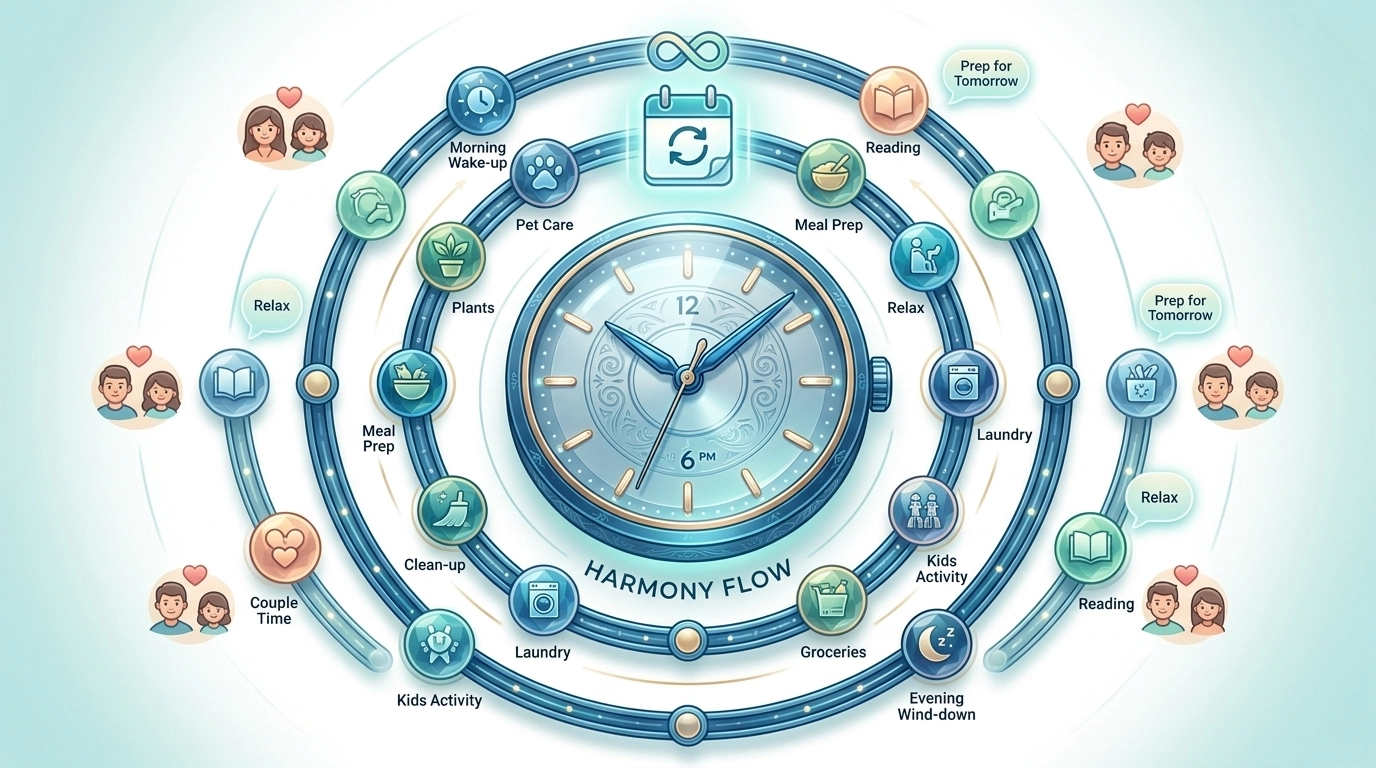
        <content type="html"><![CDATA[<p><img decoding="async" loading="lazy" src="https://cdn.marblism.com/7mMzhKd-6RL.webp" alt="A vibrant, high-fidelity illustration of a household rhythm loop that recovers and resets" class="img_ev3q"></p>
<p>Most household management systems fail not because of a lack of effort, but because of a lack of infrastructure. Whether you are a parent managing a family or a roommate in a shared apartment, the traditional "chore chart" often creates more friction than it solves. It relies on high-intensity willpower rather than a sustainable rhythm.</p>
<p>At <a href="https://docs.gethausflow.app/" target="_blank" rel="noopener noreferrer" class="">HausFlow</a>, we view home management as an operating layer for your life. When that layer is poorly designed, it leads to shame spirals, resentment, and eventual system abandonment.</p>
<p>To fix your household, you must first identify why your current tracker is breaking. Here are the 10 structural reasons shared systems fail, and how a Review -&gt; Reset loop provides the scaffolding needed for long-term success.</p>
<h2 class="anchor anchorTargetStickyNavbar_Vzrq" id="1-the-single-manager-trap">1. The "Single Manager" Trap<a href="https://docs.gethausflow.app/blog/10-reasons-your-shared-chore-tracker-isnt-working-and-how-a-reset-loop-fixes-it#1-the-single-manager-trap" class="hash-link" aria-label="Direct link to 1. The &quot;Single Manager&quot; Trap" title="Direct link to 1. The &quot;Single Manager&quot; Trap" translate="no">​</a></h2>
<p>Every spreadsheet or paper chart has an invisible project manager. This is the person who created the list, who updates the dates, and who reminds everyone else to look at it. This person is carrying the mental load of the system itself. If the manager stops managing, the system dies.</p>
<p>A functional system should be decentralized. Implementation must be shared, where the software, not a person, acts as the neutral coordinator.</p>
<h2 class="anchor anchorTargetStickyNavbar_Vzrq" id="2-invisible-labor-is-ignored">2. Invisible Labor is Ignored<a href="https://docs.gethausflow.app/blog/10-reasons-your-shared-chore-tracker-isnt-working-and-how-a-reset-loop-fixes-it#2-invisible-labor-is-ignored" class="hash-link" aria-label="Direct link to 2. Invisible Labor is Ignored" title="Direct link to 2. Invisible Labor is Ignored" translate="no">​</a></h2>
<p>Traditional trackers focus on doing, like vacuuming and dishes, but ignore the thinking, like noticing the vacuum bag is full or planning the grocery list. This invisible labor is often the root of household burnout. When tasks are not visible, they are not valued. HausFlow's philosophy is to make <a href="https://docs.gethausflow.app/" target="_blank" rel="noopener noreferrer" class="">invisible home labor visible and trackable</a>, ensuring that the thinking part of the job is acknowledged as much as the doing.</p>
<h2 class="anchor anchorTargetStickyNavbar_Vzrq" id="3-the-fallacy-of-task-parity">3. The Fallacy of Task Parity<a href="https://docs.gethausflow.app/blog/10-reasons-your-shared-chore-tracker-isnt-working-and-how-a-reset-loop-fixes-it#3-the-fallacy-of-task-parity" class="hash-link" aria-label="Direct link to 3. The Fallacy of Task Parity" title="Direct link to 3. The Fallacy of Task Parity" translate="no">​</a></h2>
<p>On a standard list, "take out the trash" and "deep clean the kitchen" often look like equal checkboxes. This lack of nuance leads to asymmetric effort. Without a way to measure the weight or intensity of a task, resentment builds because one person feels like they are doing more even if the number of completed tasks is the same.</p>
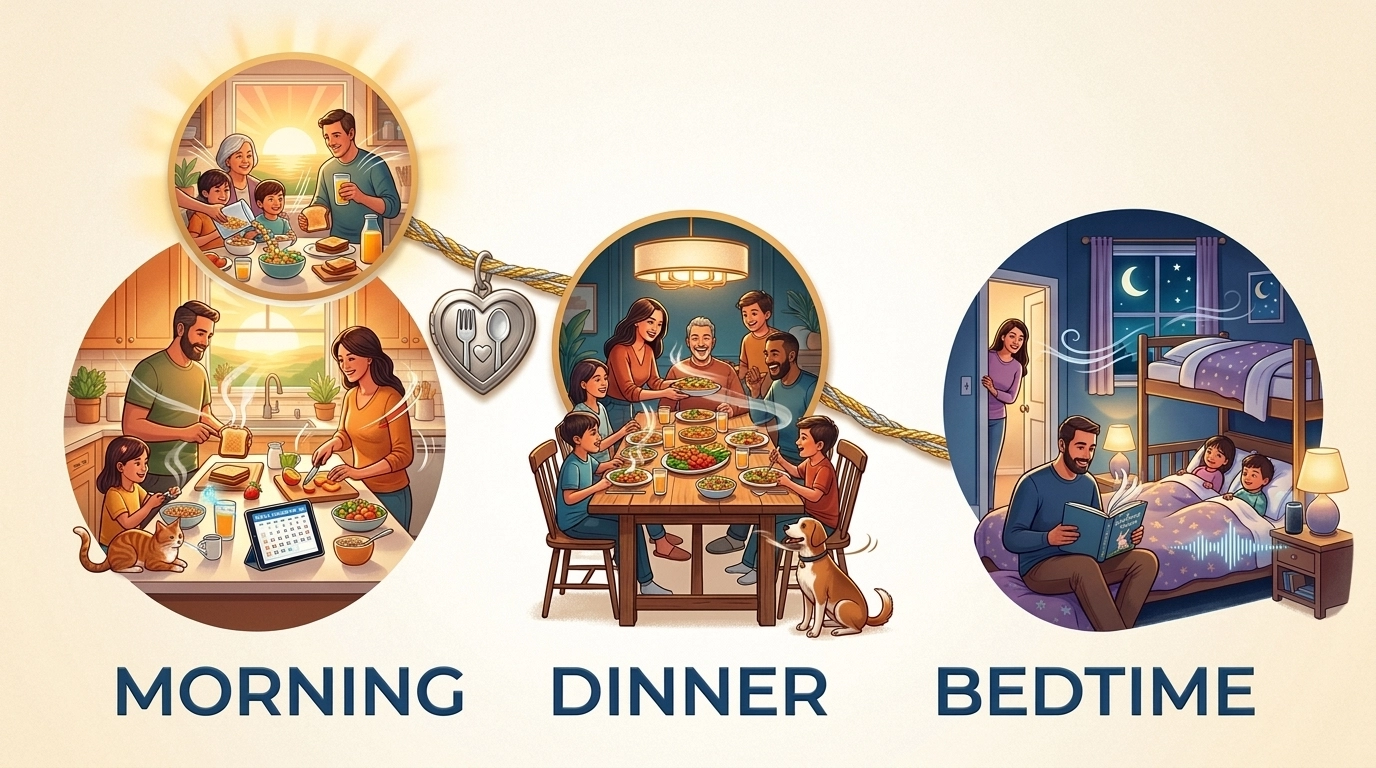
<p><img decoding="async" loading="lazy" src="https://cdn.marblism.com/YGk4l6E0j9O.webp" alt="A vibrant, high-fidelity illustration of fairness and parity in a household system" class="img_ev3q"></p>
<h2 class="anchor anchorTargetStickyNavbar_Vzrq" id="4-notification-fatigue-and-nagging">4. Notification Fatigue and Nagging<a href="https://docs.gethausflow.app/blog/10-reasons-your-shared-chore-tracker-isnt-working-and-how-a-reset-loop-fixes-it#4-notification-fatigue-and-nagging" class="hash-link" aria-label="Direct link to 4. Notification Fatigue and Nagging" title="Direct link to 4. Notification Fatigue and Nagging" translate="no">​</a></h2>
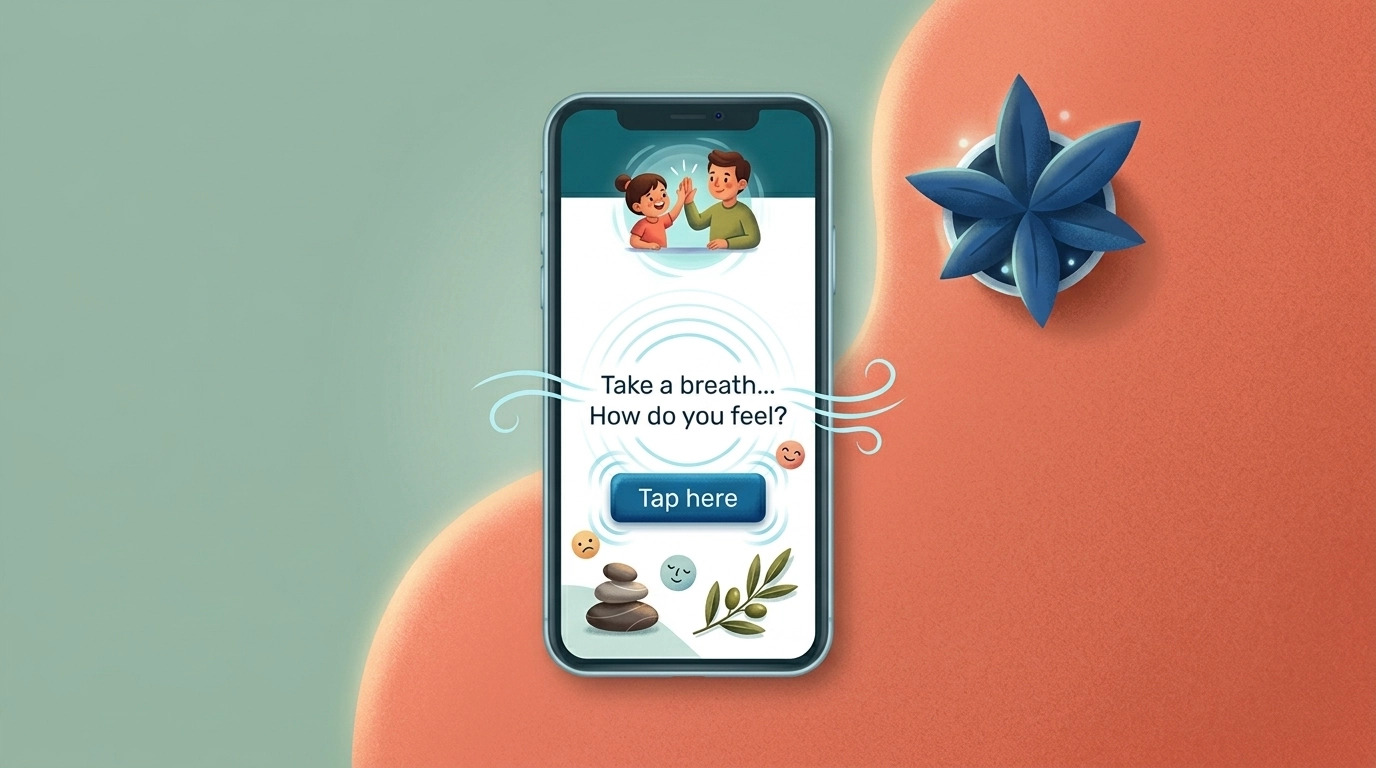
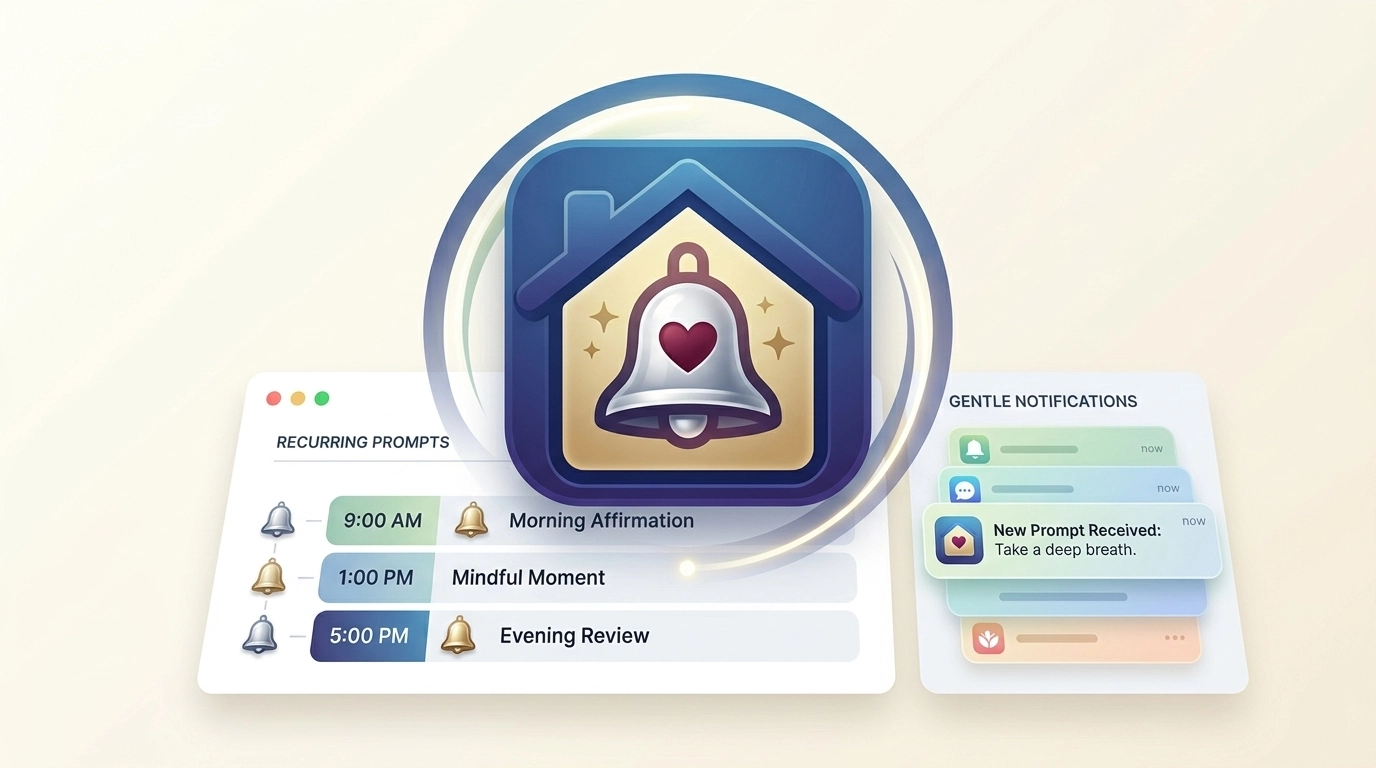
<p>When a system relies on one person reminding others, it creates a parent-child dynamic, even among roommates. This friction is a system failure. A calm-tech approach uses designed, engaging prompts: gentle, automated reminders that feel intentional, clear, and easy to respond to rather than plain alerts that fade into the background or high-pressure demands that create resistance.</p>
<h2 class="anchor anchorTargetStickyNavbar_Vzrq" id="5-rigidity-vs-messy-life">5. Rigidity vs. "Messy Life"<a href="https://docs.gethausflow.app/blog/10-reasons-your-shared-chore-tracker-isnt-working-and-how-a-reset-loop-fixes-it#5-rigidity-vs-messy-life" class="hash-link" aria-label="Direct link to 5. Rigidity vs. &quot;Messy Life&quot;" title="Direct link to 5. Rigidity vs. &quot;Messy Life&quot;" translate="no">​</a></h2>
<p>Most systems are designed for a perfect week. But life is messy. A double shift at work, a sick child, or a surprise weekend trip can break a rigid schedule. When a system cannot adapt to reality, users feel like they have failed the system, leading them to give up entirely. You need a framework that allows for gentle recovery rather than a rigid all-or-nothing mentality.</p>
<h2 class="anchor anchorTargetStickyNavbar_Vzrq" id="6-the-missing-proof-of-work">6. The Missing Proof of Work<a href="https://docs.gethausflow.app/blog/10-reasons-your-shared-chore-tracker-isnt-working-and-how-a-reset-loop-fixes-it#6-the-missing-proof-of-work" class="hash-link" aria-label="Direct link to 6. The Missing Proof of Work" title="Direct link to 6. The Missing Proof of Work" translate="no">​</a></h2>
<p>In a shared environment, out of sight often becomes out of mind. If you clean the fridge while your roommates are at work, they may never realize it happened. Without a verification step, like a quick photo or completion notification, the effort remains invisible and the contributor feels undervalued.</p>
<h2 class="anchor anchorTargetStickyNavbar_Vzrq" id="7-asymmetry-and-the-fairness-gap">7. Asymmetry and the Fairness Gap<a href="https://docs.gethausflow.app/blog/10-reasons-your-shared-chore-tracker-isnt-working-and-how-a-reset-loop-fixes-it#7-asymmetry-and-the-fairness-gap" class="hash-link" aria-label="Direct link to 7. Asymmetry and the Fairness Gap" title="Direct link to 7. Asymmetry and the Fairness Gap" translate="no">​</a></h2>
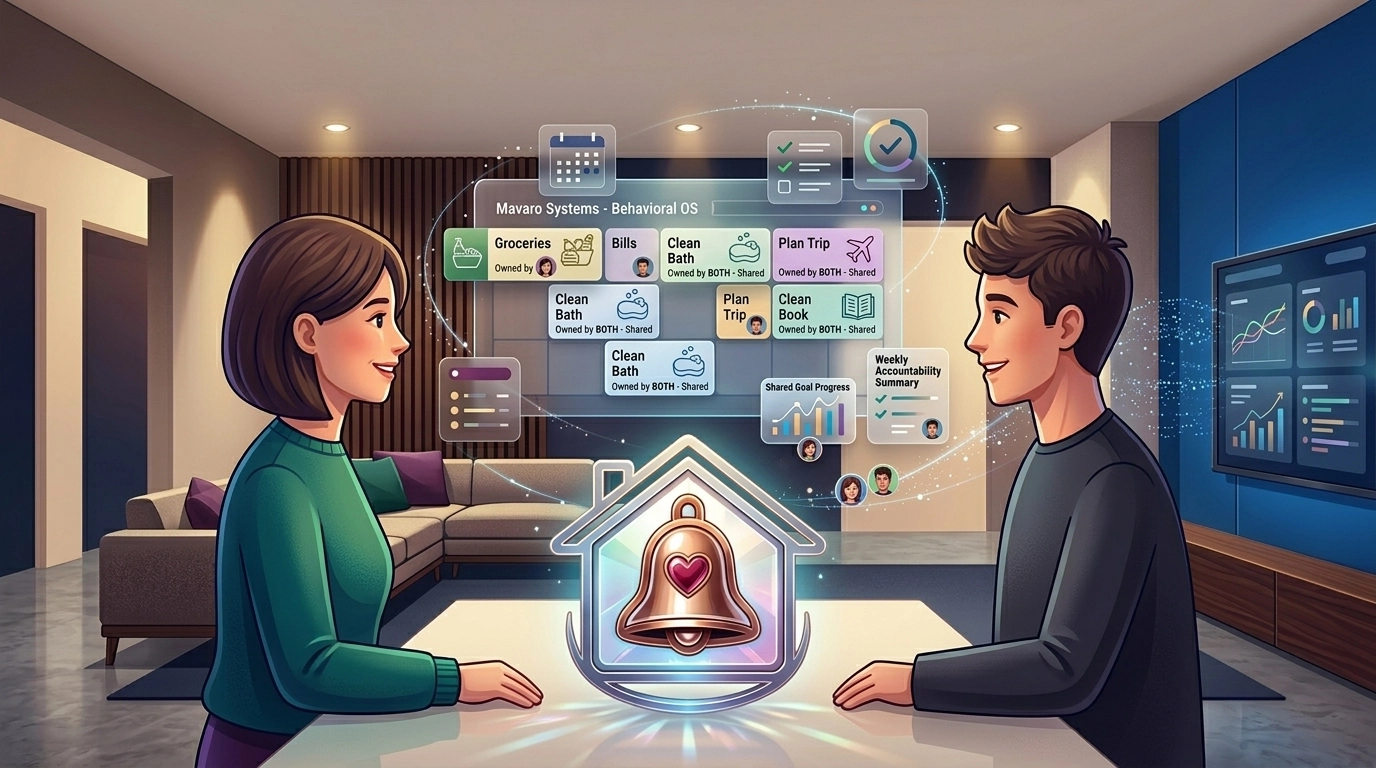
<p>Without data, discussions about chores are based on feelings. "I feel like I do everything" is a difficult statement to resolve. HausFlow uses <a href="https://docs.gethausflow.app/" target="_blank" rel="noopener noreferrer" class="">Fairness Snapshots</a> to provide a data-backed view of workload balance. Neutral accountability replaces blame when you can see the actual distribution of labor over time.</p>
<h2 class="anchor anchorTargetStickyNavbar_Vzrq" id="8-spreadsheet-overload-memory-overload">8. Spreadsheet Overload (Memory Overload)<a href="https://docs.gethausflow.app/blog/10-reasons-your-shared-chore-tracker-isnt-working-and-how-a-reset-loop-fixes-it#8-spreadsheet-overload-memory-overload" class="hash-link" aria-label="Direct link to 8. Spreadsheet Overload (Memory Overload)" title="Direct link to 8. Spreadsheet Overload (Memory Overload)" translate="no">​</a></h2>
<p>Complexity is the enemy of consistency. If your system requires opening a complex spreadsheet with multiple tabs, the friction to use it is too high. A sustainable system must be frictionless: accessible in the flow of daily life with minimal cognitive load.</p>
<h2 class="anchor anchorTargetStickyNavbar_Vzrq" id="9-the-shame-spiral">9. The Shame Spiral<a href="https://docs.gethausflow.app/blog/10-reasons-your-shared-chore-tracker-isnt-working-and-how-a-reset-loop-fixes-it#9-the-shame-spiral" class="hash-link" aria-label="Direct link to 9. The Shame Spiral" title="Direct link to 9. The Shame Spiral" translate="no">​</a></h2>
<p>When a task is missed, many systems treat it as a moral failure. The overdue notification stays red, mocking the user until they eventually delete the app. This is a shame spiral. A behavioral-first OS focuses on systems over willpower, offering paths to get back on track without the weight of guilt.</p>
<h2 class="anchor anchorTargetStickyNavbar_Vzrq" id="10-lack-of-a-clean-slate">10. Lack of a Clean Slate<a href="https://docs.gethausflow.app/blog/10-reasons-your-shared-chore-tracker-isnt-working-and-how-a-reset-loop-fixes-it#10-lack-of-a-clean-slate" class="hash-link" aria-label="Direct link to 10. Lack of a Clean Slate" title="Direct link to 10. Lack of a Clean Slate" translate="no">​</a></h2>
<p>Most trackers are linear; they just keep going until they fall apart. They lack a reset mechanism. Without a recurring point to clear the deck and start fresh, the weight of past failures prevents future progress.</p>
<h2 class="anchor anchorTargetStickyNavbar_Vzrq" id="the-secret-sauce-the-review---reset-loop">The Secret Sauce: The Review -&gt; Reset Loop<a href="https://docs.gethausflow.app/blog/10-reasons-your-shared-chore-tracker-isnt-working-and-how-a-reset-loop-fixes-it#the-secret-sauce-the-review---reset-loop" class="hash-link" aria-label="Direct link to The Secret Sauce: The Review -> Reset Loop" title="Direct link to The Secret Sauce: The Review -> Reset Loop" translate="no">​</a></h2>
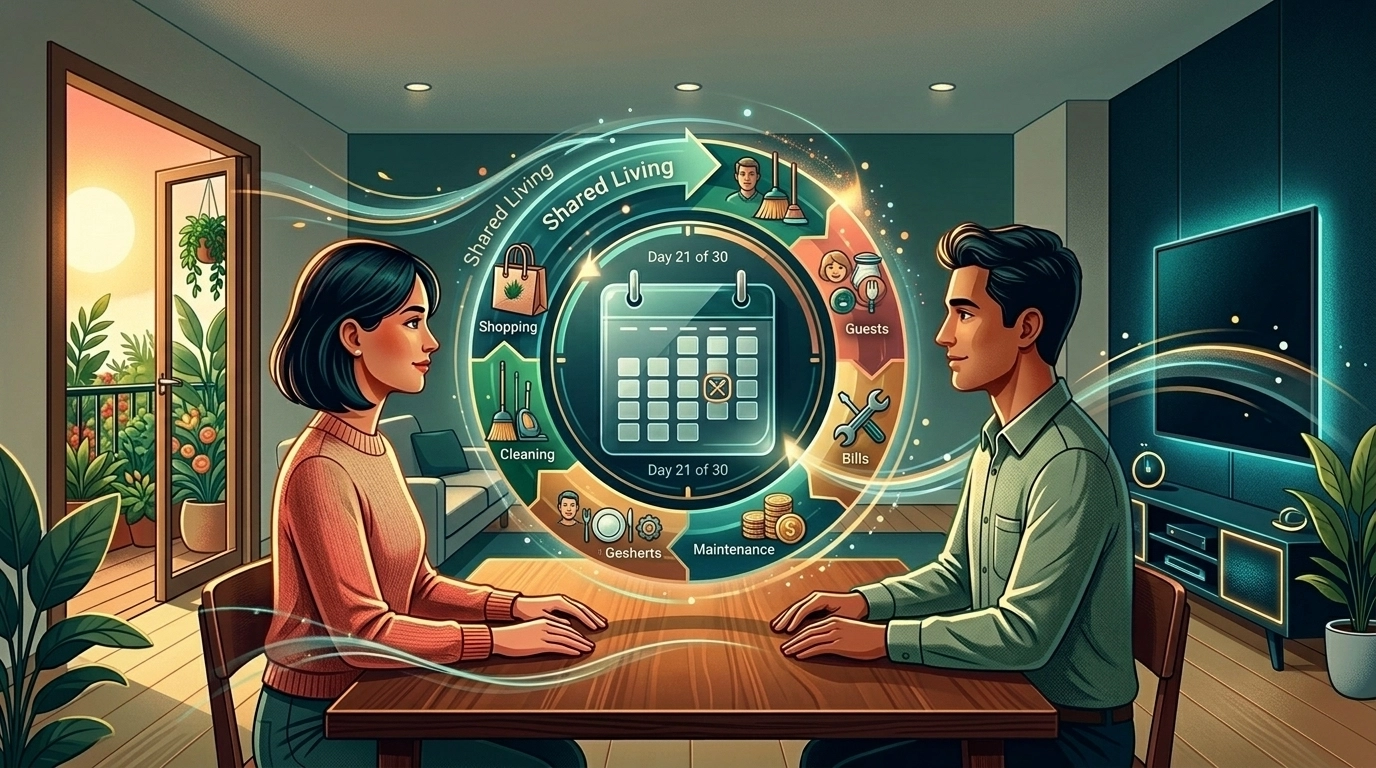
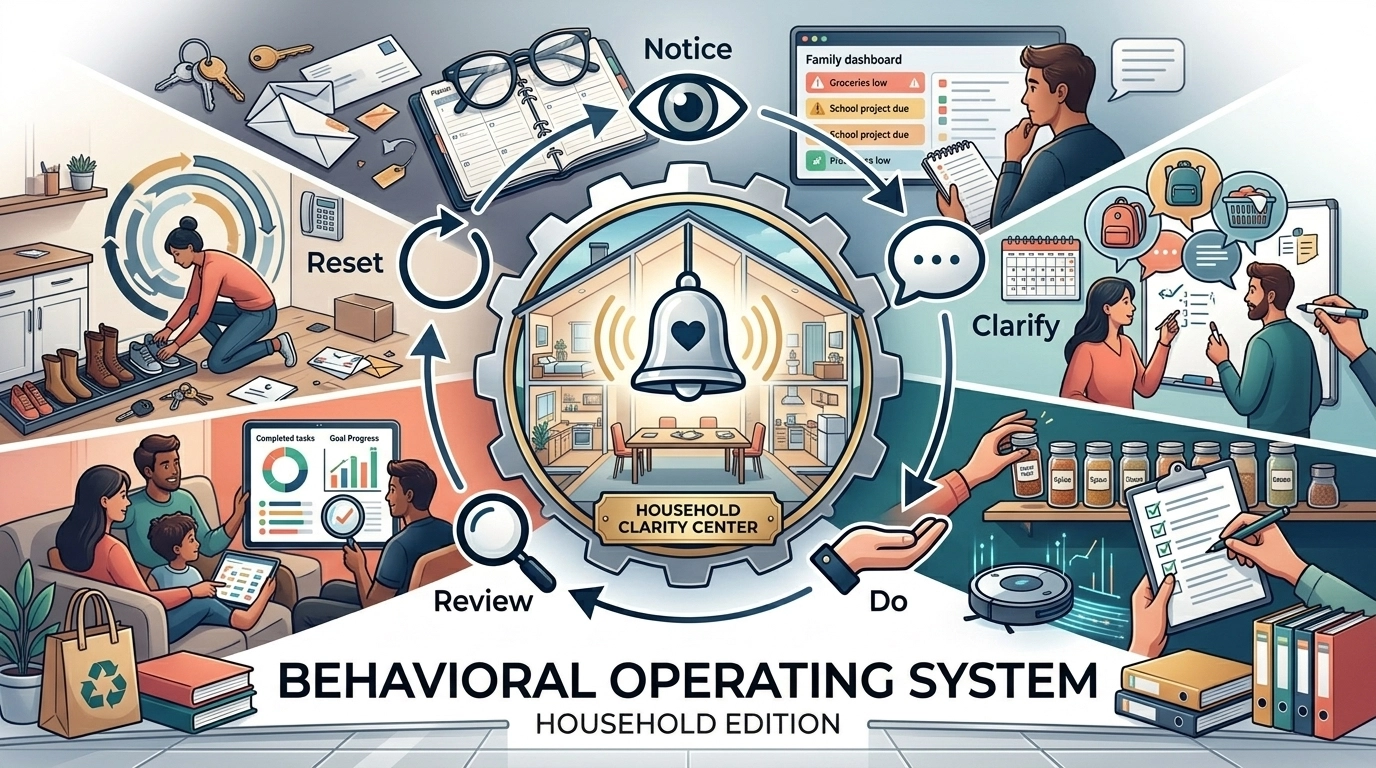
<p>To move from chaos to clarity, you need more than a list; you need a rhythm. This is where the Mavaro Systems - Behavioral OS introduces the <strong>Review -&gt; Reset Loop</strong>.</p>
<p>Instead of a never-ending list of demands, the system operates in cycles.</p>
<h3 class="anchor anchorTargetStickyNavbar_Vzrq" id="the-logic-of-the-loop">The Logic of the Loop:<a href="https://docs.gethausflow.app/blog/10-reasons-your-shared-chore-tracker-isnt-working-and-how-a-reset-loop-fixes-it#the-logic-of-the-loop" class="hash-link" aria-label="Direct link to The Logic of the Loop:" title="Direct link to The Logic of the Loop:" translate="no">​</a></h3>
<p><strong>IMPLEMENT -&gt; REVIEW -&gt; RESET</strong></p>
<ol>
<li class=""><strong>Implementation</strong>: Daily tasks are completed through <a href="https://docs.gethausflow.app/" target="_blank" rel="noopener noreferrer" class="">Harmony Flows</a>: automated routines that guide you through the day.</li>
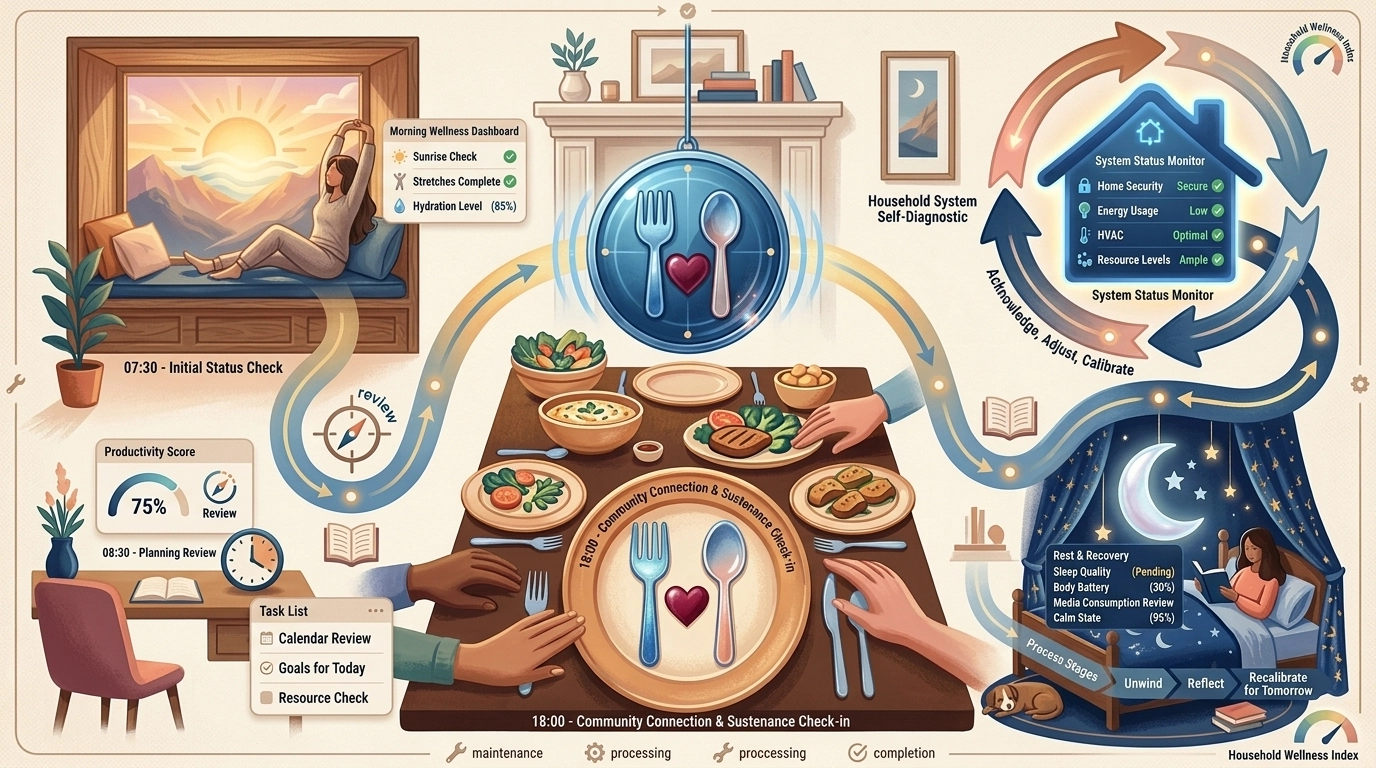
<li class=""><strong>Review</strong>: At the end of a cycle, usually a week, the household reviews the Fairness Snapshot. What worked? What did not? Who is carrying too much of the load?</li>
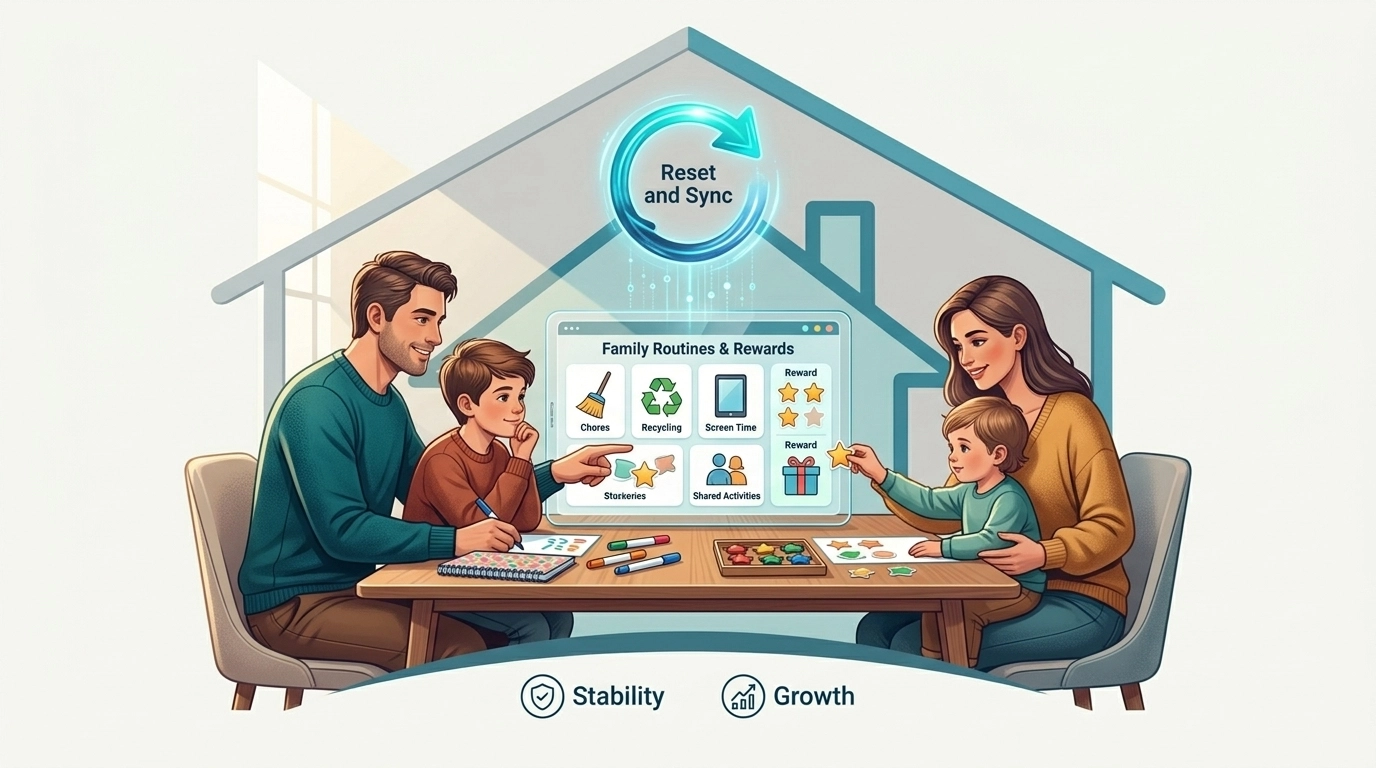
<li class=""><strong>Reset</strong>: This is the most critical step. The system resets. Any unfinished tasks are either cleared, rescheduled, or reassigned. Everyone starts the new week with a clean slate.</li>
</ol>
<p><img decoding="async" loading="lazy" src="https://cdn.marblism.com/80xjQMKz_EP.webp" alt="A vibrant, high-fidelity illustration of a household reset loop showing review and recovery stages" class="img_ev3q"></p>
<h3 class="anchor anchorTargetStickyNavbar_Vzrq" id="why-the-reset-loop-works">Why the Reset Loop Works:<a href="https://docs.gethausflow.app/blog/10-reasons-your-shared-chore-tracker-isnt-working-and-how-a-reset-loop-fixes-it#why-the-reset-loop-works" class="hash-link" aria-label="Direct link to Why the Reset Loop Works:" title="Direct link to Why the Reset Loop Works:" translate="no">​</a></h3>
<ul>
<li class=""><strong>Neutral Accountability</strong>: It moves the conversation from "Why didn't you do this?" to "How can the system support you better next week?"</li>
<li class=""><strong>Sustainable Follow-Through</strong>: It acknowledges that 100 percent completion every week is unrealistic. The goal is consistency over the long term, not perfection in the short term.</li>
<li class=""><strong>Scaffolding for Relationships</strong>: By having a scheduled Reset, you prevent small frustrations from boiling over into major arguments. The system provides the structure for the relationship to remain the priority.</li>
</ul>
<h2 class="anchor anchorTargetStickyNavbar_Vzrq" id="moving-toward-a-steadier-home">Moving Toward a Steadier Home<a href="https://docs.gethausflow.app/blog/10-reasons-your-shared-chore-tracker-isnt-working-and-how-a-reset-loop-fixes-it#moving-toward-a-steadier-home" class="hash-link" aria-label="Direct link to Moving Toward a Steadier Home" title="Direct link to Moving Toward a Steadier Home" translate="no">​</a></h2>
<p>A household should not feel like a second job. It should be a place where the infrastructure supports the people living in it. By moving away from high-pressure chore charts and toward a calm, systematic framework, you reduce friction and increase parity.</p>
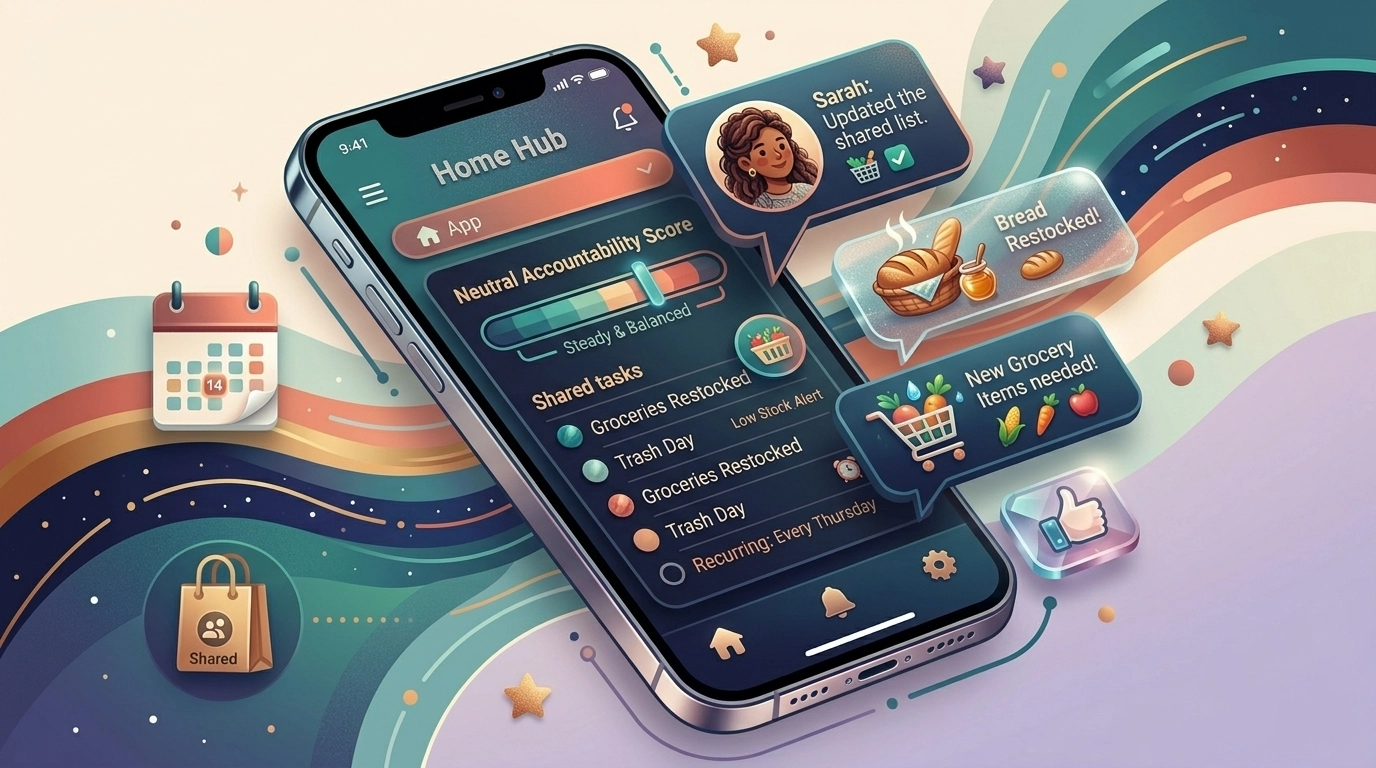
<p><img decoding="async" loading="lazy" src="https://cdn.marblism.com/QYPYlm07v8_.webp" alt="A vibrant, high-fidelity device illustration showing a designed and engaging prompt for household coordination" class="img_ev3q"></p>
<h3 class="anchor anchorTargetStickyNavbar_Vzrq" id="implementation-steps-for-your-household">Implementation Steps for Your Household:<a href="https://docs.gethausflow.app/blog/10-reasons-your-shared-chore-tracker-isnt-working-and-how-a-reset-loop-fixes-it#implementation-steps-for-your-household" class="hash-link" aria-label="Direct link to Implementation Steps for Your Household:" title="Direct link to Implementation Steps for Your Household:" translate="no">​</a></h3>
<ul>
<li class=""><strong>Define Ownership</strong>: Use visible task assignment so there is no confusion about who is responsible for what.</li>
<li class=""><strong>Embrace Neutrality</strong>: Use tools that provide designed, engaging prompts rather than plain reminders or person-to-person nagging.</li>
<li class=""><strong>Schedule the Reset</strong>: Set a 15-minute Household Check-in every Sunday to review the workload and reset the system for the week ahead.</li>
</ul>
<p>The goal is not a perfectly clean house every second of the day. The goal is a household where everyone feels the distribution of labor is fair, the expectations are clear, and the system is steady enough to handle the messiness of real life.</p>
<p><strong>Ready to build a better rhythm?</strong> Explore how <a href="https://docs.gethausflow.app/" target="_blank" rel="noopener noreferrer" class="">HausFlow Family</a> and <a href="https://docs.gethausflow.app/" target="_blank" rel="noopener noreferrer" class="">HausFlow Roommate</a> can help you transition from household chaos to systematic clarity. Sustainability is just one reset away.</p>]]></content>
        <category label="reset-loop" term="reset-loop"/>
        <category label="household-systems" term="household-systems"/>
        <category label="roommate" term="roommate"/>
        <category label="family" term="family"/>
    </entry>
    <entry>
        <title type="html"><![CDATA[Chore Charts for Adults vs. Shared Spreadsheets: Which Is Better For Your Household?]]></title>
        <id>https://docs.gethausflow.app/blog/chore-charts-for-adults-vs-shared-spreadsheets-which-is-better-for-your-household</id>
        <link href="https://docs.gethausflow.app/blog/chore-charts-for-adults-vs-shared-spreadsheets-which-is-better-for-your-household"/>
        <updated>2026-04-03T00:00:00.000Z</updated>
        <summary type="html"><![CDATA[A minimalist vector illustration showing a transition from a cluttered grid to a clean, flowing path.]]></summary>
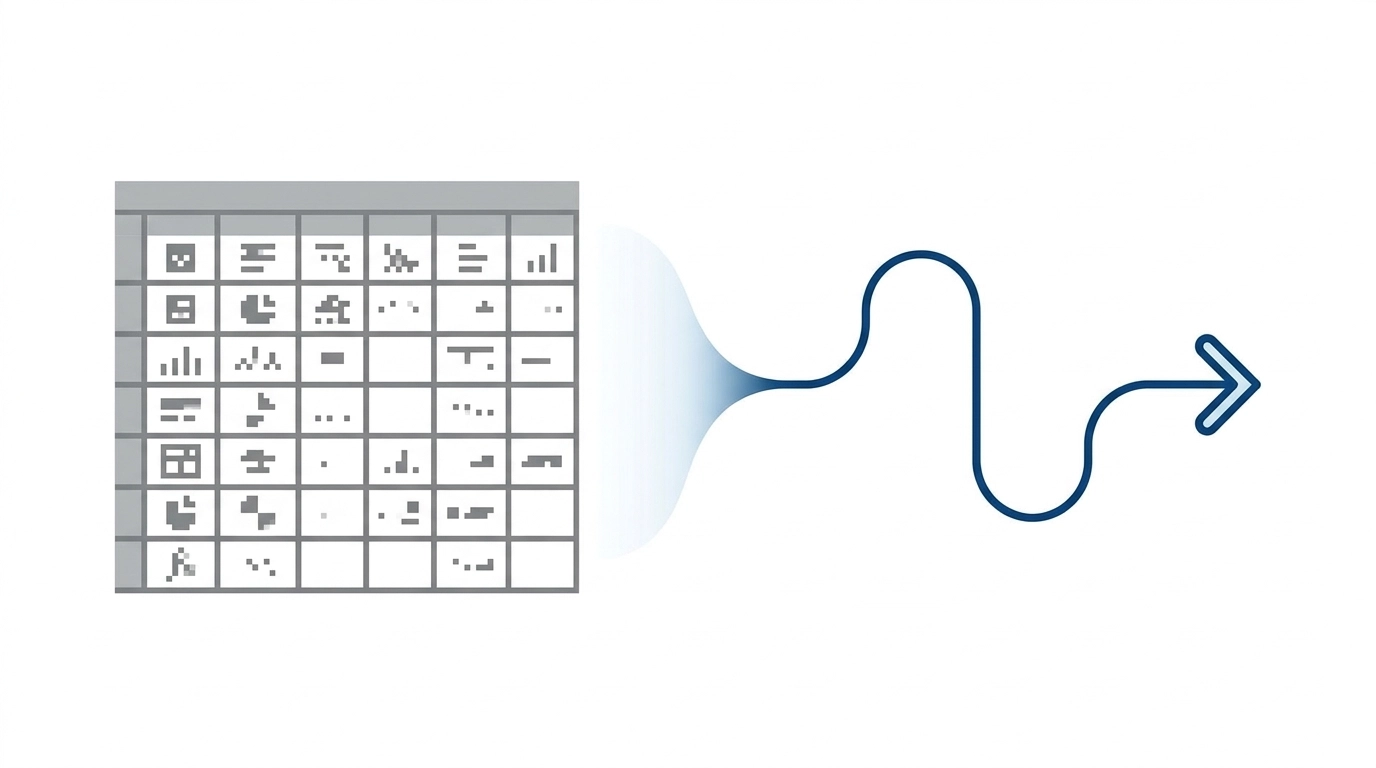
        <content type="html"><![CDATA[<p><img decoding="async" loading="lazy" src="https://cdn.marblism.com/8rkLECwxYE8.webp" alt="A minimalist vector illustration showing a transition from a cluttered grid to a clean, flowing path." class="img_ev3q"></p>
<p>Managing a modern household often feels like running a small logistics company without a department head. For many parents, the solution is either a colorful paper chart pinned to the refrigerator or a complex shared spreadsheet that eventually becomes a digital graveyard of to-do items.</p>
<p>While both methods aim to solve the problem of domestic labor, they often introduce a new form of friction: the labor of managing the tool itself. At <a href="https://docs.mavarosystems.com/" target="_blank" rel="noopener noreferrer" class="">Mavaro Systems</a>, we view household management through the lens of a <strong>Behavioral OS</strong>: an operating layer that supports human behavior rather than straining it.</p>
<p>In this guide, we compare traditional tracking methods against a systems-first approach to determine which scaffolding best supports your family’s rhythm.</p>
<h2 class="anchor anchorTargetStickyNavbar_Vzrq" id="the-paper-chore-chart-the-nostalgia-trap">The Paper Chore Chart: The Nostalgia Trap<a href="https://docs.gethausflow.app/blog/chore-charts-for-adults-vs-shared-spreadsheets-which-is-better-for-your-household#the-paper-chore-chart-the-nostalgia-trap" class="hash-link" aria-label="Direct link to The Paper Chore Chart: The Nostalgia Trap" title="Direct link to The Paper Chore Chart: The Nostalgia Trap" translate="no">​</a></h2>
<p>Paper charts are the most intuitive starting point. They are highly visible, tactile, and require zero technical setup. However, for most adults and busy families, the paper chart functions more as a guilt board than a management tool.</p>
<h3 class="anchor anchorTargetStickyNavbar_Vzrq" id="why-it-fails">Why It Fails<a href="https://docs.gethausflow.app/blog/chore-charts-for-adults-vs-shared-spreadsheets-which-is-better-for-your-household#why-it-fails" class="hash-link" aria-label="Direct link to Why It Fails" title="Direct link to Why It Fails" translate="no">​</a></h3>
<ul>
<li class=""><strong>Static reality:</strong> Life is dynamic. Paper is not.</li>
<li class=""><strong>Manual maintenance:</strong> Updating and resetting the chart usually falls on the person already carrying the mental load.</li>
<li class=""><strong>Lack of proximity:</strong> You cannot check a refrigerator door while you are at the grocery store or in the office.</li>
</ul>
<p><img decoding="async" loading="lazy" src="https://cdn.marblism.com/C2dfikGu1O8.webp" alt="A minimalist vector icon of a clipboard and a smartphone, representing the shift from analog to digital." class="img_ev3q"></p>
<h2 class="anchor anchorTargetStickyNavbar_Vzrq" id="the-shared-spreadsheet-the-data-graveyard">The Shared Spreadsheet: The Data Graveyard<a href="https://docs.gethausflow.app/blog/chore-charts-for-adults-vs-shared-spreadsheets-which-is-better-for-your-household#the-shared-spreadsheet-the-data-graveyard" class="hash-link" aria-label="Direct link to The Shared Spreadsheet: The Data Graveyard" title="Direct link to The Shared Spreadsheet: The Data Graveyard" translate="no">​</a></h2>
<p>For the digitally inclined, a shared Google Sheet or Excel file feels like a professional upgrade. It allows for complex sorting, automated date calculations, and remote access. Yet spreadsheets often fail for a different reason: they lack a pulse.</p>
<h3 class="anchor anchorTargetStickyNavbar_Vzrq" id="the-spreadsheet-friction">The Spreadsheet Friction<a href="https://docs.gethausflow.app/blog/chore-charts-for-adults-vs-shared-spreadsheets-which-is-better-for-your-household#the-spreadsheet-friction" class="hash-link" aria-label="Direct link to The Spreadsheet Friction" title="Direct link to The Spreadsheet Friction" translate="no">​</a></h3>
<ul>
<li class=""><strong>High barrier to entry:</strong> Opening a browser and zooming into a cell is too much friction for small household actions.</li>
<li class=""><strong>No active feedback:</strong> Spreadsheets are passive. They do not send calm prompts when a task is due.</li>
<li class=""><strong>Data vs. action:</strong> A spreadsheet tracks what should happen but does nothing to support the behavior needed to make it happen.</li>
</ul>
<h2 class="anchor anchorTargetStickyNavbar_Vzrq" id="the-hausflow-way-a-behavioral-os">The HausFlow Way: A Behavioral OS<a href="https://docs.gethausflow.app/blog/chore-charts-for-adults-vs-shared-spreadsheets-which-is-better-for-your-household#the-hausflow-way-a-behavioral-os" class="hash-link" aria-label="Direct link to The HausFlow Way: A Behavioral OS" title="Direct link to The HausFlow Way: A Behavioral OS" translate="no">​</a></h2>
<p>HausFlow was designed to bridge the gap between knowing what to do and actually doing it. Instead of a static list, HausFlow provides an active operating layer for your home.</p>
<h3 class="anchor anchorTargetStickyNavbar_Vzrq" id="1-visible-ownership-and-neutral-accountability">1. Visible Ownership and Neutral Accountability<a href="https://docs.gethausflow.app/blog/chore-charts-for-adults-vs-shared-spreadsheets-which-is-better-for-your-household#1-visible-ownership-and-neutral-accountability" class="hash-link" aria-label="Direct link to 1. Visible Ownership and Neutral Accountability" title="Direct link to 1. Visible Ownership and Neutral Accountability" translate="no">​</a></h3>
<p>Confusion is the primary source of household friction. When responsibility is vague, resentment grows. HausFlow makes ownership explicit. Each task is assigned to a specific person, removing the need for verbal reminders.</p>
<h3 class="anchor anchorTargetStickyNavbar_Vzrq" id="2-harmony-flows">2. Harmony Flows<a href="https://docs.gethausflow.app/blog/chore-charts-for-adults-vs-shared-spreadsheets-which-is-better-for-your-household#2-harmony-flows" class="hash-link" aria-label="Direct link to 2. Harmony Flows" title="Direct link to 2. Harmony Flows" translate="no">​</a></h3>
<p>Rather than reinventing the wheel every week, HausFlow uses <strong>Harmony Flows</strong>. These are recurring routines that trigger automatically.</p>
<p><code>TRIGGER -&gt; ASSIGNMENT -&gt; VERIFICATION</code></p>
<h3 class="anchor anchorTargetStickyNavbar_Vzrq" id="3-the-fairness-snapshot">3. The Fairness Snapshot<a href="https://docs.gethausflow.app/blog/chore-charts-for-adults-vs-shared-spreadsheets-which-is-better-for-your-household#3-the-fairness-snapshot" class="hash-link" aria-label="Direct link to 3. The Fairness Snapshot" title="Direct link to 3. The Fairness Snapshot" translate="no">​</a></h3>
<p>One of the most powerful parts of the HausFlow system is the ability to track workload parity. By visualizing who is doing what, the system provides neutral data that can be used during a weekly reset to balance the load without blame or shame.</p>
<p><img decoding="async" loading="lazy" src="https://cdn.marblism.com/EpQekMCcW0d.webp" alt="A minimalist vector illustration of a scale, representing workload parity and fairness." class="img_ev3q"></p>
<h2 class="anchor anchorTargetStickyNavbar_Vzrq" id="comparison-at-a-glance">Comparison: At a Glance<a href="https://docs.gethausflow.app/blog/chore-charts-for-adults-vs-shared-spreadsheets-which-is-better-for-your-household#comparison-at-a-glance" class="hash-link" aria-label="Direct link to Comparison: At a Glance" title="Direct link to Comparison: At a Glance" translate="no">​</a></h2>
<table><thead><tr><th style="text-align:left">Feature</th><th style="text-align:left">Paper Chart</th><th style="text-align:left">Shared Spreadsheet</th><th style="text-align:left">HausFlow (Behavioral OS)</th></tr></thead><tbody><tr><td style="text-align:left"><strong>Setup Effort</strong></td><td style="text-align:left">Low</td><td style="text-align:left">High</td><td style="text-align:left">Medium (System Design)</td></tr><tr><td style="text-align:left"><strong>Maintenance</strong></td><td style="text-align:left">Manual</td><td style="text-align:left">Manual</td><td style="text-align:left">Automated</td></tr><tr><td style="text-align:left"><strong>Accountability</strong></td><td style="text-align:left">Visual only</td><td style="text-align:left">Passive</td><td style="text-align:left">Neutral and Prompted</td></tr><tr><td style="text-align:left"><strong>Accessibility</strong></td><td style="text-align:left">Kitchen only</td><td style="text-align:left">Anywhere (clunky)</td><td style="text-align:left">Mobile-first / Proximity</td></tr><tr><td style="text-align:left"><strong>Feedback Loop</strong></td><td style="text-align:left">None</td><td style="text-align:left">None</td><td style="text-align:left">Rewards, XP, and Proof</td></tr></tbody></table>
<h2 class="anchor anchorTargetStickyNavbar_Vzrq" id="the-missing-link-the-reset-loop">The Missing Link: The Reset Loop<a href="https://docs.gethausflow.app/blog/chore-charts-for-adults-vs-shared-spreadsheets-which-is-better-for-your-household#the-missing-link-the-reset-loop" class="hash-link" aria-label="Direct link to The Missing Link: The Reset Loop" title="Direct link to The Missing Link: The Reset Loop" translate="no">​</a></h2>
<p>The reason most chore systems fail is that they lack a recovery mechanism. When a day is missed on a paper chart, the system feels broken, leading to a shame spiral and eventual abandonment.</p>
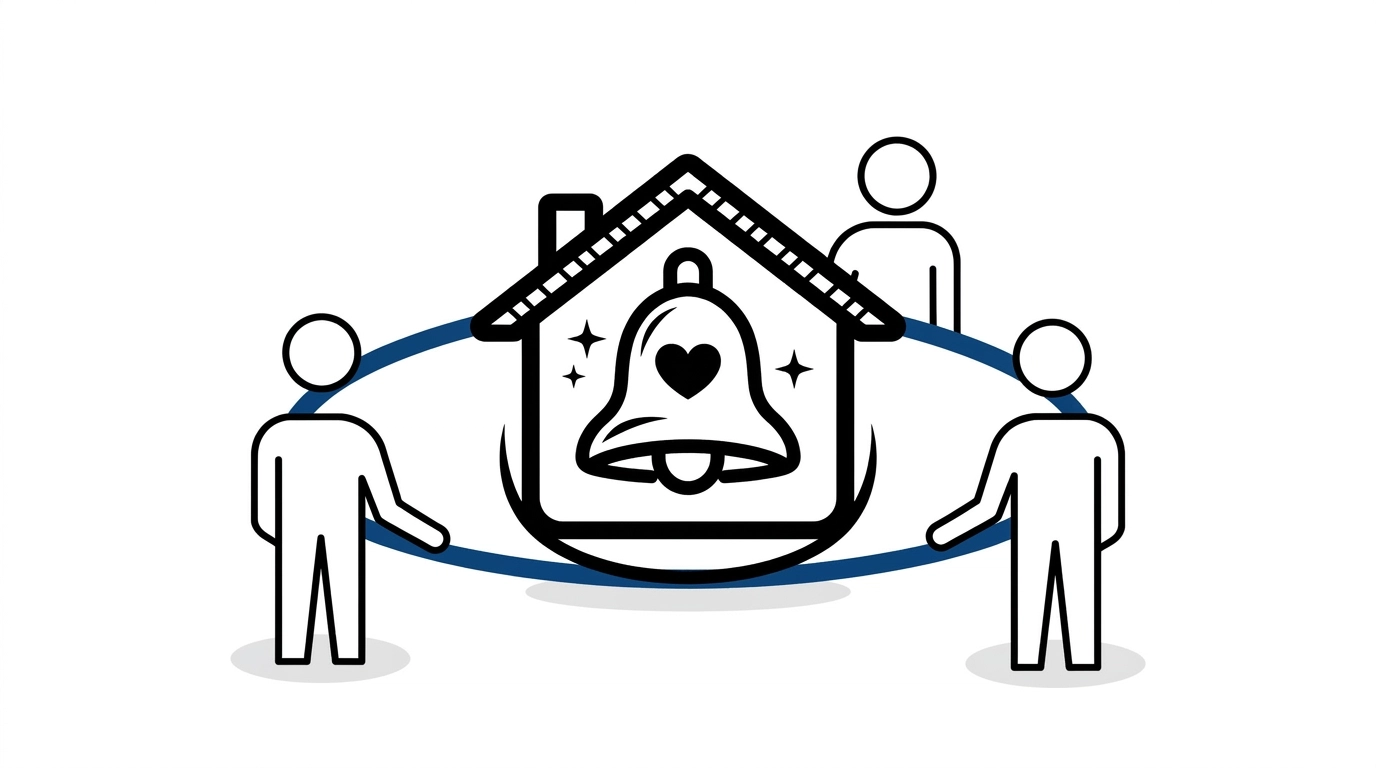
<p>HausFlow incorporates a <strong>Guided Reset</strong>. This is a dedicated interval, usually weekly, where the household reviews the previous cycle and adjusts for the next.</p>
<p><strong>The reset logic:</strong>
<code>REVIEW DATA -&gt; ACKNOWLEDGE EFFORT (XP) -&gt; ADJUST CAPACITY -&gt; RE-START FLOW</code></p>
<p><img decoding="async" loading="lazy" src="https://cdn.marblism.com/J2ML8sa_Vvt.webp" alt="Three figures connected by a deep blue loop, representing household harmony and shared responsibility." class="img_ev3q"></p>
<h2 class="anchor anchorTargetStickyNavbar_Vzrq" id="summary-moving-toward-sustainability">Summary: Moving Toward Sustainability<a href="https://docs.gethausflow.app/blog/chore-charts-for-adults-vs-shared-spreadsheets-which-is-better-for-your-household#summary-moving-toward-sustainability" class="hash-link" aria-label="Direct link to Summary: Moving Toward Sustainability" title="Direct link to Summary: Moving Toward Sustainability" translate="no">​</a></h2>
<p>A household system should not require more energy to maintain than the tasks it is meant to track. Paper charts are too fragile for modern life, and spreadsheets are too cold and friction-heavy.</p>
<p>HausFlow offers a steadier path. By focusing on scaffolding rather than willpower, it creates an environment where responsibilities are clear, labor is visible, and the goal is sustainable progress over unattainable perfection.</p>
<p>If you are ready to move from chaos to clarity, explore our <a href="https://docs.gethausflow.app/" target="_blank" rel="noopener noreferrer" class="">documentation</a> to see how to implement your first Harmony Flow.</p>]]></content>
        <category label="household-systems" term="household-systems"/>
        <category label="harmony-flows" term="harmony-flows"/>
        <category label="shared-living" term="shared-living"/>
        <category label="hausflow" term="hausflow"/>
    </entry>
    <entry>
        <title type="html"><![CDATA[Why Mapping Invisible Labor Will Change the Way You Partner and Parent]]></title>
        <id>https://docs.gethausflow.app/blog/why-mapping-invisible-labor-will-change-the-way-you-partner-and-parent</id>
        <link href="https://docs.gethausflow.app/blog/why-mapping-invisible-labor-will-change-the-way-you-partner-and-parent"/>
        <updated>2026-04-03T00:00:00.000Z</updated>
        <summary type="html"><![CDATA[heroImage]]></summary>
        <content type="html"><![CDATA[<p><img decoding="async" loading="lazy" src="https://cdn.marblism.com/be4ICefrIya.webp" alt="heroImage" class="img_ev3q"></p>
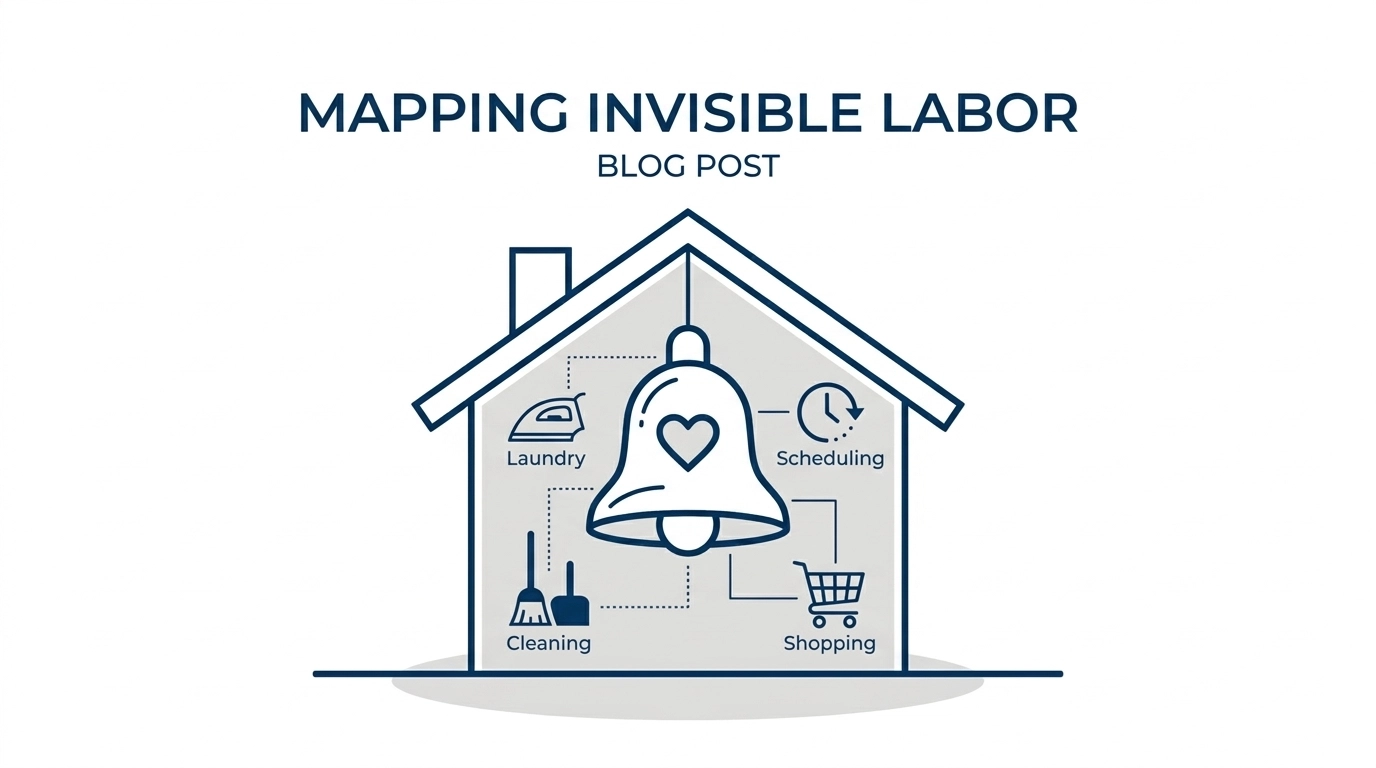
<p>In many households, the most exhausting work is not the work that is seen. It is the work that is felt. It is the mental list of which child needs new shoes, the anticipation of a grocery shortage before the milk carton is empty, and the coordination of a weekend schedule that keeps everyone’s commitments from colliding. This is invisible labor: the cognitive and emotional management of a home.</p>
<p>When invisible labor remains unmapped, it leads to a predictable cycle of vague expectations, resentment, and eventual burnout. Without a shared system of record, household management relies entirely on willpower and memory. This is unsustainable. At Mavaro Systems, we view the home not just as a place of residence, but as a complex operating environment that requires a functional operating layer to thrive.</p>
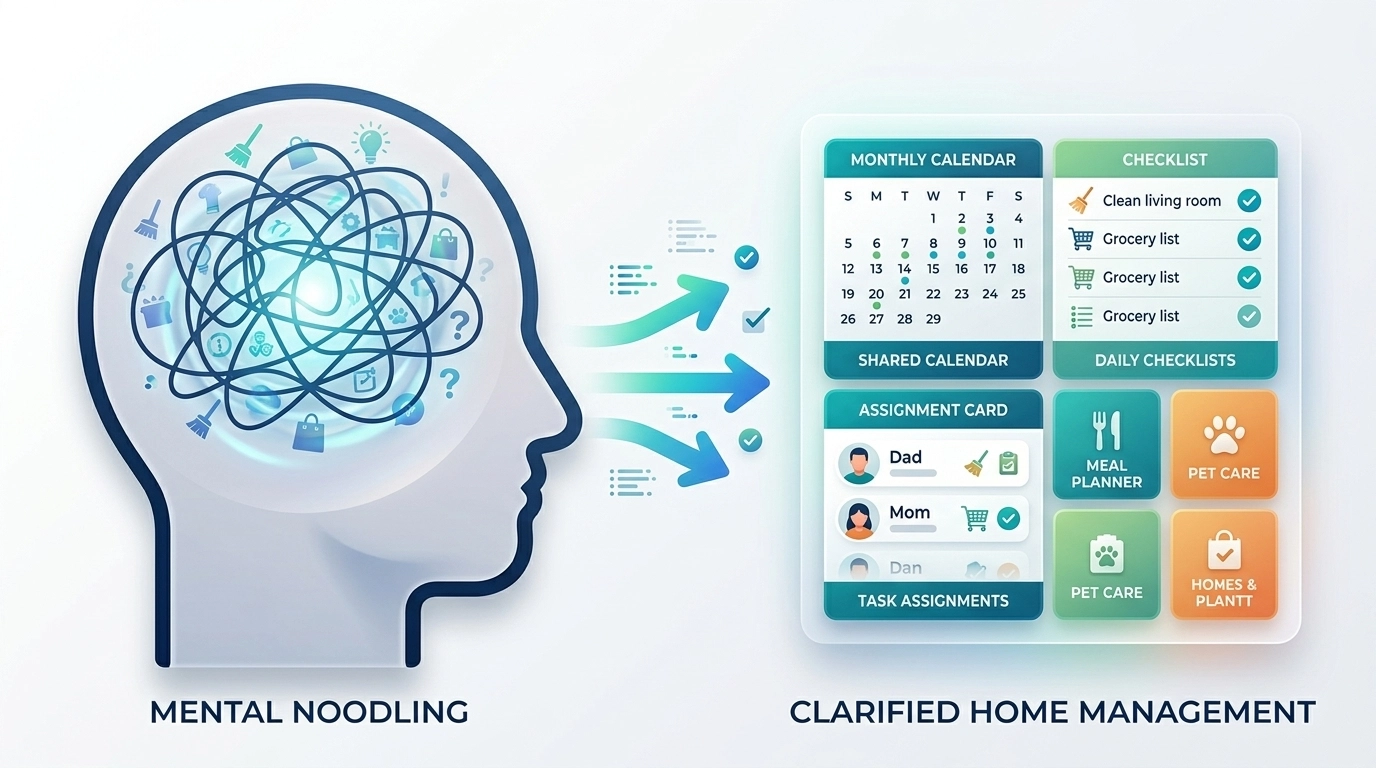
<p>By shifting from a state of internal tracking to visible external systems, you move the burden of management from your mind to shared scaffolding. This transition is what we call moving from chaos to clarity.</p>
<h2 class="anchor anchorTargetStickyNavbar_Vzrq" id="the-two-dimensions-of-the-mental-load">The Two Dimensions of the Mental Load<a href="https://docs.gethausflow.app/blog/why-mapping-invisible-labor-will-change-the-way-you-partner-and-parent#the-two-dimensions-of-the-mental-load" class="hash-link" aria-label="Direct link to The Two Dimensions of the Mental Load" title="Direct link to The Two Dimensions of the Mental Load" translate="no">​</a></h2>
<p>To map invisible labor, we must first define its components. Most families focus only on execution, the act of doing the dishes or driving to soccer practice. However, execution is only the final step of a much larger cognitive process.</p>
<h3 class="anchor anchorTargetStickyNavbar_Vzrq" id="1-the-cognitive-dimension">1. The Cognitive Dimension<a href="https://docs.gethausflow.app/blog/why-mapping-invisible-labor-will-change-the-way-you-partner-and-parent#1-the-cognitive-dimension" class="hash-link" aria-label="Direct link to 1. The Cognitive Dimension" title="Direct link to 1. The Cognitive Dimension" translate="no">​</a></h3>
<p>This involves the planning, tracking, and decision-making required for a household to function.</p>
<ul>
<li class=""><strong>Anticipation:</strong> Knowing that school spirit day is next Tuesday</li>
<li class=""><strong>Information management:</strong> Keeping track of where the spare keys are</li>
<li class=""><strong>Decision making:</strong> Choosing which detergent is safest for a baby’s skin</li>
</ul>
<h3 class="anchor anchorTargetStickyNavbar_Vzrq" id="2-the-emotional-dimension">2. The Emotional Dimension<a href="https://docs.gethausflow.app/blog/why-mapping-invisible-labor-will-change-the-way-you-partner-and-parent#2-the-emotional-dimension" class="hash-link" aria-label="Direct link to 2. The Emotional Dimension" title="Direct link to 2. The Emotional Dimension" translate="no">​</a></h3>
<p>This involves the management of the family’s internal state.</p>
<ul>
<li class=""><strong>Holding space:</strong> Managing a toddler’s tantrum while tracking your own regulation</li>
<li class=""><strong>Translation:</strong> Explaining a child’s needs to a partner or teacher</li>
<li class=""><strong>Monitoring:</strong> Sensing when a partner is nearing their limit</li>
</ul>
<p>When these dimensions are not mapped, one partner typically becomes the project manager while the other becomes the helper. This dynamic creates friction on both sides.</p>
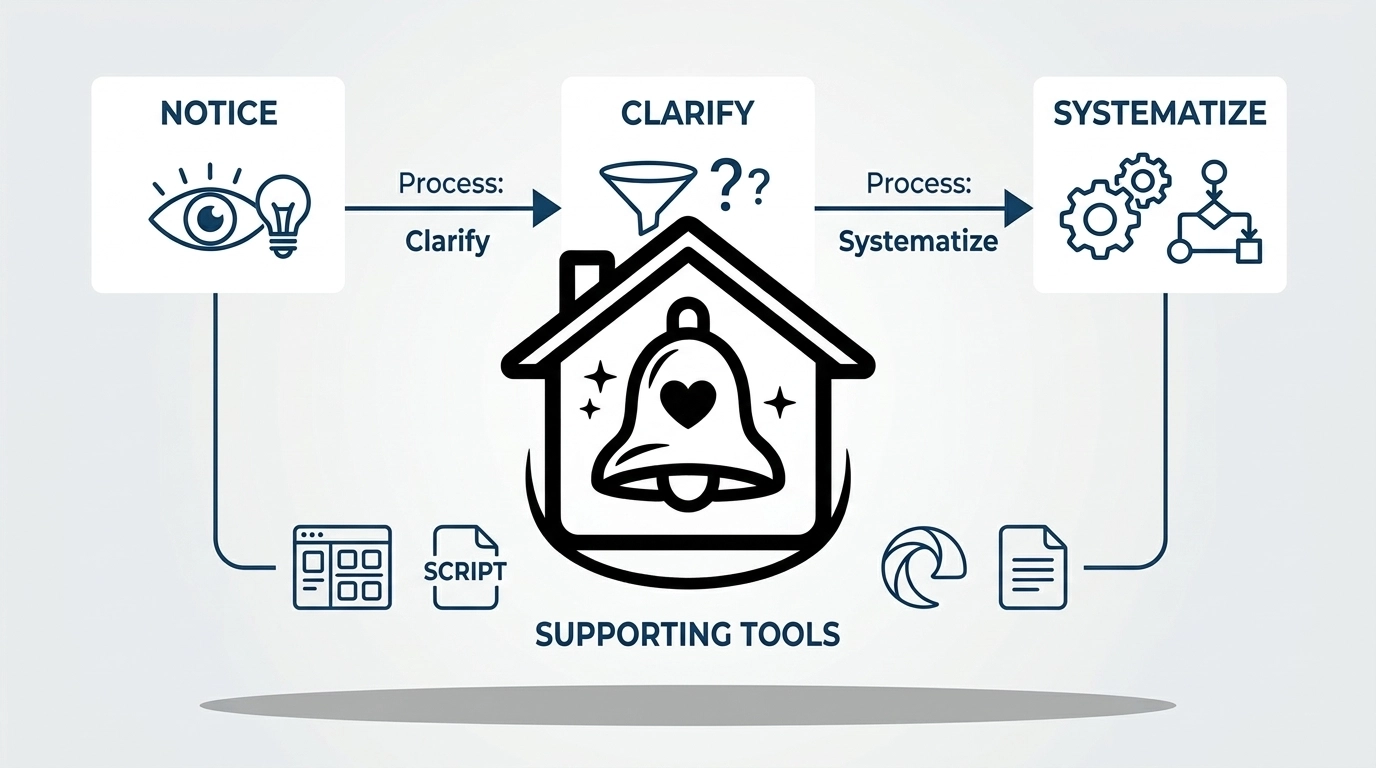
<h2 class="anchor anchorTargetStickyNavbar_Vzrq" id="the-mavaro-behavioral-os-notice---clarify---systematize">The Mavaro Behavioral OS: Notice -&gt; Clarify -&gt; Systematize<a href="https://docs.gethausflow.app/blog/why-mapping-invisible-labor-will-change-the-way-you-partner-and-parent#the-mavaro-behavioral-os-notice---clarify---systematize" class="hash-link" aria-label="Direct link to The Mavaro Behavioral OS: Notice -> Clarify -> Systematize" title="Direct link to The Mavaro Behavioral OS: Notice -> Clarify -> Systematize" translate="no">​</a></h2>
<p>Mapping invisible labor requires systematic logic. We use a three-step framework within the Mavaro Behavioral OS to move labor from invisible to trackable.</p>
<p><img decoding="async" loading="lazy" src="https://cdn.marblism.com/h9P4cEJ2mQG.webp" alt="Notice Clarify Systematize" class="img_ev3q"></p>
<h3 class="anchor anchorTargetStickyNavbar_Vzrq" id="step-1-notice">Step 1: Notice<a href="https://docs.gethausflow.app/blog/why-mapping-invisible-labor-will-change-the-way-you-partner-and-parent#step-1-notice" class="hash-link" aria-label="Direct link to Step 1: Notice" title="Direct link to Step 1: Notice" translate="no">​</a></h3>
<p>The first step is a neutral audit. It is the process of identifying everything currently held in the mind.</p>
<ul>
<li class=""><strong>The philosophy:</strong> If it requires a thought, it is a task.</li>
<li class=""><strong>The current reality:</strong> Most households only notice labor when it fails.</li>
</ul>
<h3 class="anchor anchorTargetStickyNavbar_Vzrq" id="step-2-clarify">Step 2: Clarify<a href="https://docs.gethausflow.app/blog/why-mapping-invisible-labor-will-change-the-way-you-partner-and-parent#step-2-clarify" class="hash-link" aria-label="Direct link to Step 2: Clarify" title="Direct link to Step 2: Clarify" translate="no">​</a></h3>
<p>Once a task or responsibility is noticed, it must be clarified. This is where we define ownership. In HausFlow, we move away from help and toward primary ownership. The owner is responsible for the full lifecycle of the task.</p>
<h3 class="anchor anchorTargetStickyNavbar_Vzrq" id="step-3-systematize">Step 3: Systematize<a href="https://docs.gethausflow.app/blog/why-mapping-invisible-labor-will-change-the-way-you-partner-and-parent#step-3-systematize" class="hash-link" aria-label="Direct link to Step 3: Systematize" title="Direct link to Step 3: Systematize" translate="no">​</a></h3>
<p>The final step is moving the clarified task into a <strong>Harmony Flow</strong>. By creating recurring routines and visible assignments, the system becomes the referee. The person who needs the shoes no longer has to remind their partner. The system provides the prompt.</p>
<h2 class="anchor anchorTargetStickyNavbar_Vzrq" id="fairness-snapshots-turning-resentment-into-data">Fairness Snapshots: Turning Resentment into Data<a href="https://docs.gethausflow.app/blog/why-mapping-invisible-labor-will-change-the-way-you-partner-and-parent#fairness-snapshots-turning-resentment-into-data" class="hash-link" aria-label="Direct link to Fairness Snapshots: Turning Resentment into Data" title="Direct link to Fairness Snapshots: Turning Resentment into Data" translate="no">​</a></h2>
<p>One of the greatest sources of friction in a partnership is the feeling of parity, or the lack of it. Without data, discussions about workload are based on feelings, which are often shaped by the stress of the moment.</p>
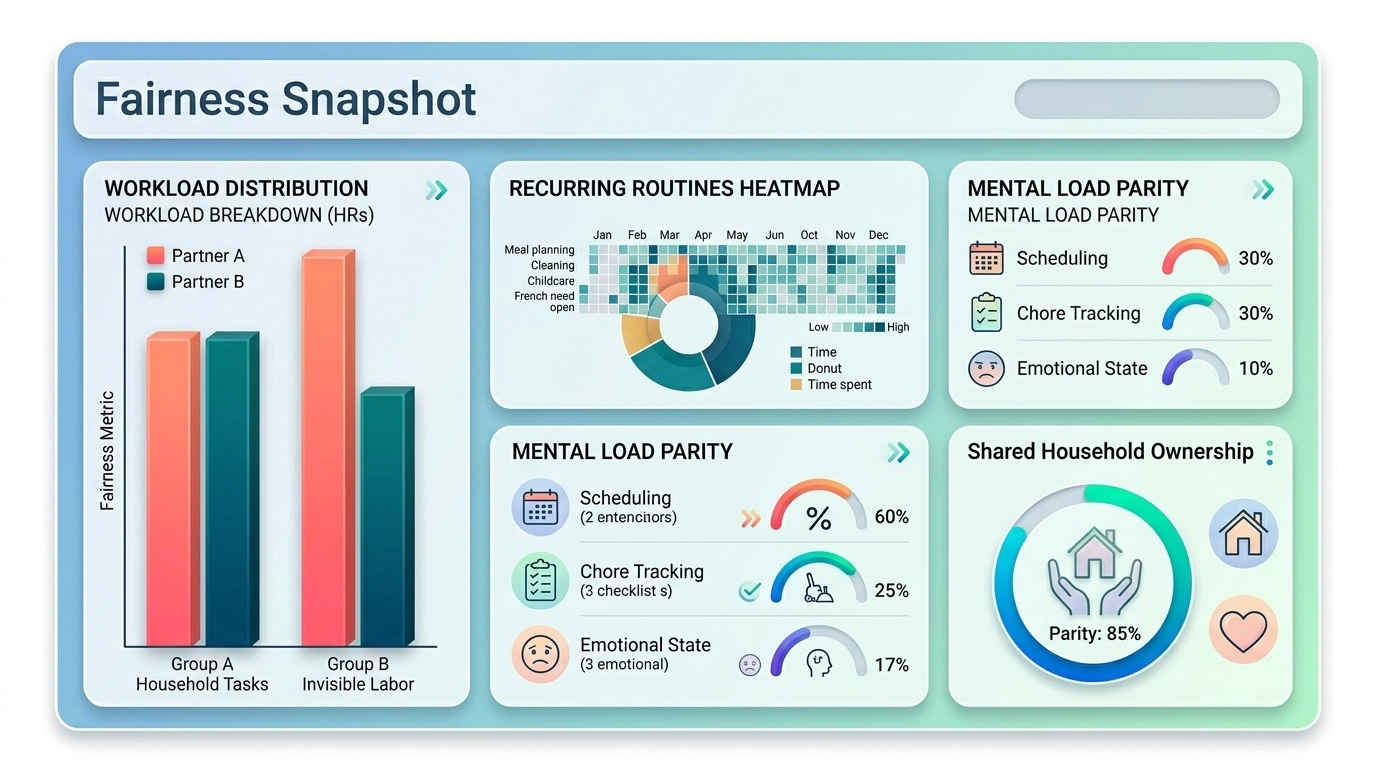
<p>HausFlow introduces the <strong>Fairness Snapshot</strong>. This is a neutral, data-driven view of the household workload. It does not exist to assign blame. It exists to provide a mirror.</p>
<p><img decoding="async" loading="lazy" src="https://cdn.marblism.com/4mWsPuX04Wj.webp" alt="Fairness Snapshot" class="img_ev3q"></p>
<p>When you can see that one partner is carrying most of the cognitive load while the other is handling a smaller part of the execution load, you can have a pragmatic conversation about balance.</p>
<p><strong>The goal of parity:</strong></p>
<ol>
<li class=""><strong>Visibility:</strong> Ensuring invisible tasks are weighted alongside visible ones</li>
<li class=""><strong>Neutral accountability:</strong> The app tracks completion and follow-through</li>
<li class=""><strong>Workload balance:</strong> Adjusting assignments based on current season of life</li>
</ol>
<h2 class="anchor anchorTargetStickyNavbar_Vzrq" id="moving-toward-sustainable-follow-through">Moving Toward Sustainable Follow-Through<a href="https://docs.gethausflow.app/blog/why-mapping-invisible-labor-will-change-the-way-you-partner-and-parent#moving-toward-sustainable-follow-through" class="hash-link" aria-label="Direct link to Moving Toward Sustainable Follow-Through" title="Direct link to Moving Toward Sustainable Follow-Through" translate="no">​</a></h2>
<p>A system is only as good as its ability to recover. In the calm-tech philosophy, we acknowledge that life is messy. Kids get sick, work deadlines shift, and systems break.</p>
<p>The traditional approach relies on intensity and willpower. When the system fails, the people feel shame. HausFlow replaces this shame spiral with a <strong>Guided Reset</strong>.</p>
<p><img decoding="async" loading="lazy" src="https://cdn.marblism.com/eXcKrdBDR2p.webp" alt="Household Reset Loop" class="img_ev3q"></p>
<p>A Household Reset is a brief, structured check-in. It allows partners to look at the previous week’s data, acknowledge where the rhythm was lost, and adjust the scaffolding for the week ahead. This focus on systems over willpower helps the home run as a steady rhythm rather than as a series of high-pressure sprints.</p>
<h3 class="anchor anchorTargetStickyNavbar_Vzrq" id="the-impact-on-parenting">The Impact on Parenting<a href="https://docs.gethausflow.app/blog/why-mapping-invisible-labor-will-change-the-way-you-partner-and-parent#the-impact-on-parenting" class="hash-link" aria-label="Direct link to The Impact on Parenting" title="Direct link to The Impact on Parenting" translate="no">​</a></h3>
<p>When parents map their invisible labor, they model healthy boundaries and organizational rigor for their children. By using the <a href="https://docs.gethausflow.app/" target="_blank" rel="noopener noreferrer" class="">HausFlow Family</a> tools, kids can see that a home does not just run. It is managed.</p>
<h2 class="anchor anchorTargetStickyNavbar_Vzrq" id="implementation-how-to-start-mapping-today">Implementation: How to Start Mapping Today<a href="https://docs.gethausflow.app/blog/why-mapping-invisible-labor-will-change-the-way-you-partner-and-parent#implementation-how-to-start-mapping-today" class="hash-link" aria-label="Direct link to Implementation: How to Start Mapping Today" title="Direct link to Implementation: How to Start Mapping Today" translate="no">​</a></h2>
<p>Moving from mental load to a visual system does not happen overnight. It requires commitment to implementation.</p>
<ol>
<li class=""><strong>The brain dump:</strong> Sit down with your partner and list every recurring thought you have about the home.</li>
<li class=""><strong>Identify the ownership gap:</strong> Look at who is the noticer for each item.</li>
<li class=""><strong>Define your Harmony Flows:</strong> Choose the top three sources of friction and build them into <a href="https://docs.gethausflow.app/" target="_blank" rel="noopener noreferrer" class="">HausFlow</a>.</li>
<li class=""><strong>Trust the scaffolding:</strong> Once a task is in the system, the noticer has to step back and let the owner manage the lifecycle.</li>
</ol>
<h2 class="anchor anchorTargetStickyNavbar_Vzrq" id="summary-progress-over-perfection">Summary: Progress Over Perfection<a href="https://docs.gethausflow.app/blog/why-mapping-invisible-labor-will-change-the-way-you-partner-and-parent#summary-progress-over-perfection" class="hash-link" aria-label="Direct link to Summary: Progress Over Perfection" title="Direct link to Summary: Progress Over Perfection" translate="no">​</a></h2>
<p>Mapping invisible labor is not about achieving a perfect, sterile home. It is about creating a steadier, more frictionless environment where every member of the household feels seen and supported.</p>
<p>By using a systems-first logic and the Mavaro Behavioral OS, you transition from the exhausting role of a solo manager to the sustainable role of a collaborative partner. Clarity is the antidote to resentment. Structure supports relationships.</p>
<p>For more guides on managing your household with calm and clarity, explore our <a href="https://docs.gethausflow.app/blog" target="_blank" rel="noopener noreferrer" class="">full documentation and blog</a>.</p>]]></content>
        <category label="invisible-labor" term="invisible-labor"/>
        <category label="parenting-systems" term="parenting-systems"/>
        <category label="fairness" term="fairness"/>
        <category label="hausflow" term="hausflow"/>
    </entry>
    <entry>
        <title type="html"><![CDATA[Gamifying the Garbage: Raising Accountable Kids with HausFlow XP and Rewards]]></title>
        <id>https://docs.gethausflow.app/blog/gamifying-the-garbage-raising-accountable-kids-with-hausflow-xp-and-rewards</id>
        <link href="https://docs.gethausflow.app/blog/gamifying-the-garbage-raising-accountable-kids-with-hausflow-xp-and-rewards"/>
        <updated>2026-04-01T00:00:00.000Z</updated>
        <summary type="html"><![CDATA[Raising Accountable Kids with HausFlow XP and Rewards]]></summary>
        <content type="html"><![CDATA[<p><img decoding="async" loading="lazy" src="https://cdn.marblism.com/RhXcAL0wPD3.webp" alt="Raising Accountable Kids with HausFlow XP and Rewards" class="img_ev3q"></p>
<p>Managing a household with children often devolves into a cycle of willpower battles. Parents rely on reminders, which escalate into nagging, and eventually culminate in frustration when tasks remain incomplete. This approach is biologically taxing. It requires high intensity from the parent to drive action from the child.</p>
<p>At Mavaro Systems LLC, we view the home not as a series of chores, but as a system of human behaviors. To move from chaos to clarity, we must transition away from willpower-based parenting and toward a structured operating layer.</p>
<p><strong>HausFlow Family</strong> is built on the <strong>Mavaro Systems - Behavioral OS</strong>. This framework replaces friction with rhythm, using gamification not as a distraction, but as scaffolding for accountability. By utilizing Experience Points (XP), proof verification, and the Review -&gt; Reset cycle, we can raise kids who understand the mechanics of contribution without the emotional drama.</p>
<h2 class="anchor anchorTargetStickyNavbar_Vzrq" id="the-problem-the-high-cost-of-invisible-labor">The Problem: The High Cost of Invisible Labor<a href="https://docs.gethausflow.app/blog/gamifying-the-garbage-raising-accountable-kids-with-hausflow-xp-and-rewards#the-problem-the-high-cost-of-invisible-labor" class="hash-link" aria-label="Direct link to The Problem: The High Cost of Invisible Labor" title="Direct link to The Problem: The High Cost of Invisible Labor" translate="no">​</a></h2>
<p>Invisible labor is often defined as the mental load of managing a household. For parents, this load is heaviest when they act as the sole enforcer of routines. When a child forgets the garbage, the parent must:</p>
<ol>
<li class="">Notice the oversight.</li>
<li class="">Recall whose responsibility it was.</li>
<li class="">Initiate a verbal prompt.</li>
<li class="">Follow up to ensure completion.</li>
</ol>
<p>This process is inefficient. It creates a shame spiral where the child feels pressured and the parent feels ignored. <strong>Mavaro Systems - Behavioral OS</strong> solves this by making the invisible visible and the expectations neutral.</p>
<h2 class="anchor anchorTargetStickyNavbar_Vzrq" id="the-incentive-layer-xp-and-rewards">The Incentive Layer: XP and Rewards<a href="https://docs.gethausflow.app/blog/gamifying-the-garbage-raising-accountable-kids-with-hausflow-xp-and-rewards#the-incentive-layer-xp-and-rewards" class="hash-link" aria-label="Direct link to The Incentive Layer: XP and Rewards" title="Direct link to The Incentive Layer: XP and Rewards" translate="no">​</a></h2>
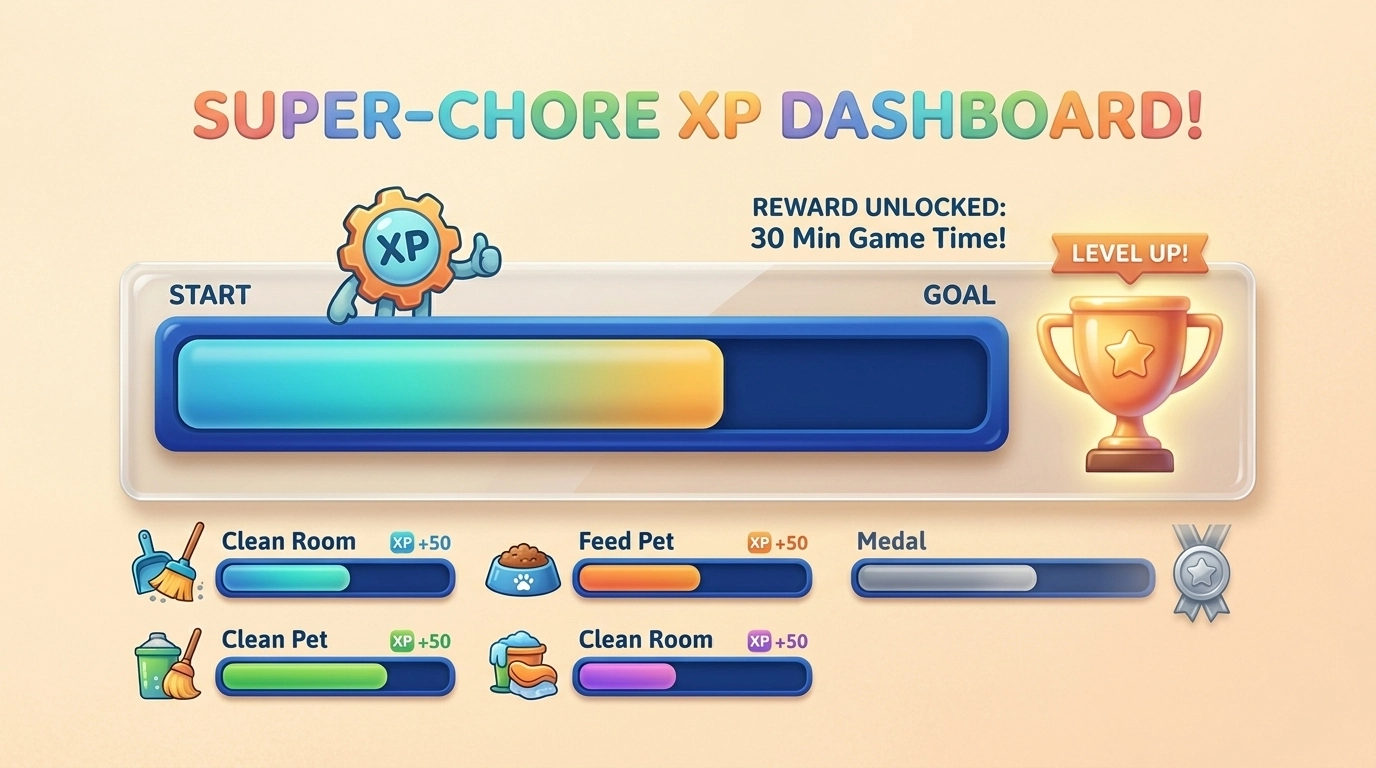
<p>Incentives are often confused with bribes. A bribe is offered in the heat of a struggle to stop a behavior. An incentive is a pre-negotiated reward for a completed system. HausFlow utilizes an Experience Points system to provide immediate, tangible feedback for household contributions.</p>
<h3 class="anchor anchorTargetStickyNavbar_Vzrq" id="how-xp-functions">How XP Functions<a href="https://docs.gethausflow.app/blog/gamifying-the-garbage-raising-accountable-kids-with-hausflow-xp-and-rewards#how-xp-functions" class="hash-link" aria-label="Direct link to How XP Functions" title="Direct link to How XP Functions" translate="no">​</a></h3>
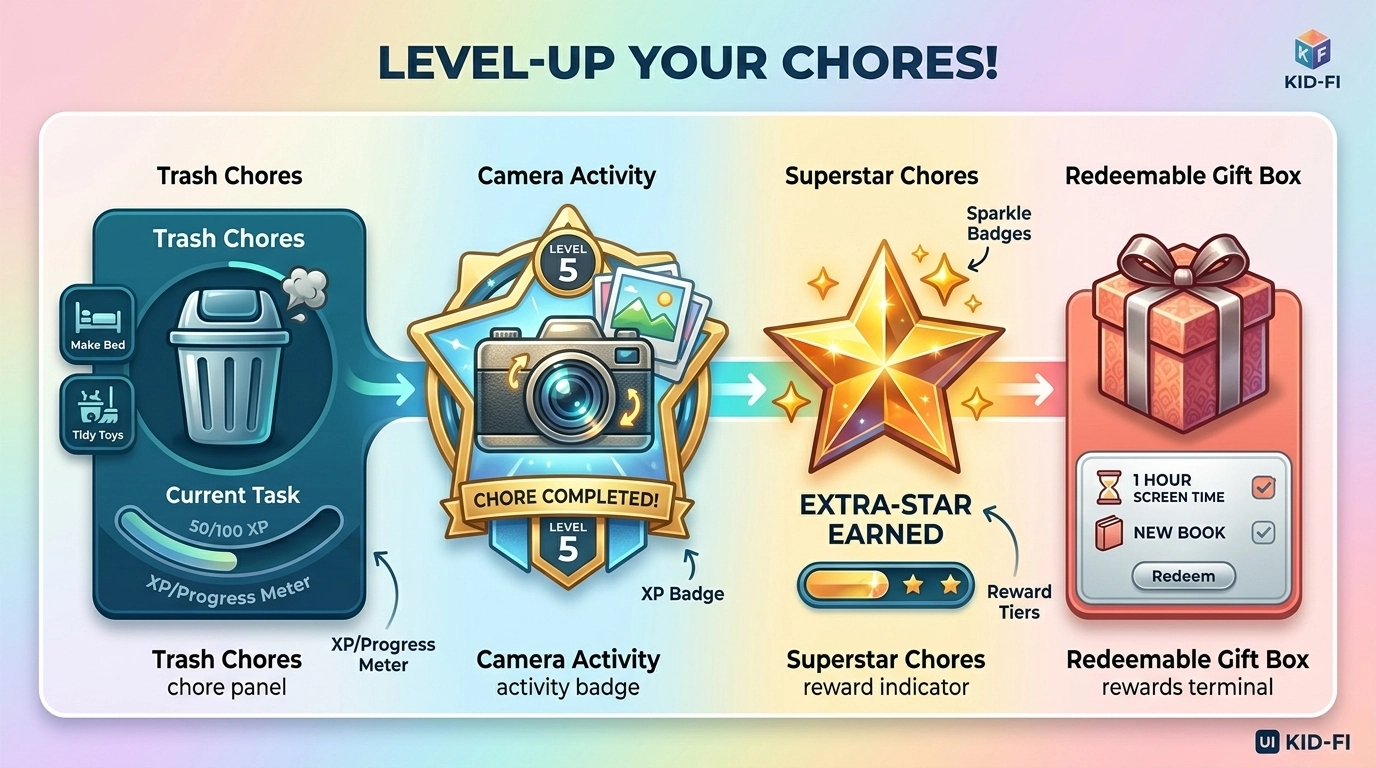
<p>Every task assigned within a <strong>Harmony Flow</strong> carries a specific XP weight.</p>
<ul>
<li class=""><strong>Maintenance tasks (low XP):</strong> Brushing teeth, making the bed</li>
<li class=""><strong>Contribution tasks (medium XP):</strong> Setting the table, loading the dishwasher</li>
<li class=""><strong>Deep work (high XP):</strong> Cleaning the garage, organizing the pantry</li>
</ul>
<p>By attaching XP to these actions, we shift the child's focus from the burden of the task to the growth of their profile. This creates a psychological rhythm of effort and reward.</p>
<p><img decoding="async" loading="lazy" src="https://cdn.marblism.com/p_ztY-NRLln.webp" alt="XP and Rewards logic flow" class="img_ev3q"></p>
<h3 class="anchor anchorTargetStickyNavbar_Vzrq" id="sustainable-rewards">Sustainable Rewards<a href="https://docs.gethausflow.app/blog/gamifying-the-garbage-raising-accountable-kids-with-hausflow-xp-and-rewards#sustainable-rewards" class="hash-link" aria-label="Direct link to Sustainable Rewards" title="Direct link to Sustainable Rewards" translate="no">​</a></h3>
<p>The Rewards system in HausFlow is customizable. We recommend focusing on access-based rewards rather than purely material ones.</p>
<ul>
<li class=""><strong>100 XP:</strong> 30 minutes of extra screen time</li>
<li class=""><strong>500 XP:</strong> Choosing the Friday night movie</li>
<li class=""><strong>1000 XP:</strong> A solo trip to the park with a parent</li>
</ul>
<p>This structure teaches kids that contribution leads to community benefits. It provides a steady, predictable pathway to agency.</p>
<h2 class="anchor anchorTargetStickyNavbar_Vzrq" id="the-neutral-referee-proof-verification">The Neutral Referee: Proof Verification<a href="https://docs.gethausflow.app/blog/gamifying-the-garbage-raising-accountable-kids-with-hausflow-xp-and-rewards#the-neutral-referee-proof-verification" class="hash-link" aria-label="Direct link to The Neutral Referee: Proof Verification" title="Direct link to The Neutral Referee: Proof Verification" translate="no">​</a></h2>
<p>One of the greatest sources of friction in a household is the dispute over completion quality. A child says the room is clean. A parent disagrees. This creates a subjective conflict.</p>
<p>HausFlow removes this friction through <strong>Proof Verification</strong>. When a task is completed, the child provides proof, usually a photo or a quick check-in, through the app.</p>
<h3 class="anchor anchorTargetStickyNavbar_Vzrq" id="the-verification-workflow">The Verification Workflow<a href="https://docs.gethausflow.app/blog/gamifying-the-garbage-raising-accountable-kids-with-hausflow-xp-and-rewards#the-verification-workflow" class="hash-link" aria-label="Direct link to The Verification Workflow" title="Direct link to The Verification Workflow" translate="no">​</a></h3>
<p>The logic follows a linear, non-negotiable path:</p>
<p><code>TASK ASSIGNED -&gt; ACTION TAKEN -&gt; PHOTO PROOF UPLOADED -&gt; PARENTAL APPROVAL -&gt; XP ISSUED</code></p>
<p>By requiring a photo of the emptied garbage bin, the system becomes the referee. The parent does not have to walk to the kitchen to check. They simply review the proof in the app. If the task does not meet the standard, the prompt remains active.</p>
<p><img decoding="async" loading="lazy" src="https://cdn.marblism.com/yuC6cOh73Vg.webp" alt="HausFlow Neutral Prompts" class="img_ev3q"></p>
<p><em>Visualizing the calm prompt system: HausFlow uses gentle notifications to keep the household rhythm steady.</em></p>
<h2 class="anchor anchorTargetStickyNavbar_Vzrq" id="the-progress-bar-visualizing-workload-parity">The Progress Bar: Visualizing Workload Parity<a href="https://docs.gethausflow.app/blog/gamifying-the-garbage-raising-accountable-kids-with-hausflow-xp-and-rewards#the-progress-bar-visualizing-workload-parity" class="hash-link" aria-label="Direct link to The Progress Bar: Visualizing Workload Parity" title="Direct link to The Progress Bar: Visualizing Workload Parity" translate="no">​</a></h2>
<p>Children, and many adults, struggle to conceptualize their contribution to the whole. They often feel they are doing everything because they only experience their own effort.</p>
<p>HausFlow's <strong>Fairness Snapshot</strong> and XP progress bars provide a visual representation of household parity. When a child sees their progress bar moving closer to a reward, it provides a sense of accomplishment. More importantly, it shows them their role within the family ecosystem.</p>
<p><img decoding="async" loading="lazy" src="https://cdn.marblism.com/szh1HFQPG1t.webp" alt="XP Progress Bar Visualization" class="img_ev3q"></p>
<p>This visibility reduces the need for verbal praise or criticism. The data speaks for itself.</p>
<h2 class="anchor anchorTargetStickyNavbar_Vzrq" id="the-operating-layer-review---reset">The Operating Layer: Review -&gt; Reset<a href="https://docs.gethausflow.app/blog/gamifying-the-garbage-raising-accountable-kids-with-hausflow-xp-and-rewards#the-operating-layer-review---reset" class="hash-link" aria-label="Direct link to The Operating Layer: Review -> Reset" title="Direct link to The Operating Layer: Review -> Reset" translate="no">​</a></h2>
<p>Systems eventually encounter friction. Life gets messy, schedules change, and routines break down. The <strong>Mavaro Systems - Behavioral OS</strong> accounts for this through the <strong>Review -&gt; Reset</strong> cycle.</p>
<h3 class="anchor anchorTargetStickyNavbar_Vzrq" id="the-weekly-review">The Weekly Review<a href="https://docs.gethausflow.app/blog/gamifying-the-garbage-raising-accountable-kids-with-hausflow-xp-and-rewards#the-weekly-review" class="hash-link" aria-label="Direct link to The Weekly Review" title="Direct link to The Weekly Review" translate="no">​</a></h3>
<p>Instead of addressing issues in the heat of the moment, families use HausFlow to conduct a weekly review. This is a short scheduled check-in where the family looks at the data from the previous week:</p>
<ul>
<li class="">Which Harmony Flows worked?</li>
<li class="">Which tasks were consistently missed?</li>
<li class="">Who earned the most XP?</li>
</ul>
<h3 class="anchor anchorTargetStickyNavbar_Vzrq" id="the-reset">The Reset<a href="https://docs.gethausflow.app/blog/gamifying-the-garbage-raising-accountable-kids-with-hausflow-xp-and-rewards#the-reset" class="hash-link" aria-label="Direct link to The Reset" title="Direct link to The Reset" translate="no">​</a></h3>
<p>The Reset is a gentle recovery system. If a child fell behind, the Reset is the moment to clear the slate and adjust the scaffolding. Perhaps the garbage task is too heavy for Tuesday nights because of soccer practice. We do not blame the child. We adjust the system.</p>
<p><img decoding="async" loading="lazy" src="https://cdn.marblism.com/NJT8FIkwbBl.webp" alt="Family Review and Reset Meeting" class="img_ev3q"></p>
<p><strong>The logic of the reset:</strong>
<code>DATA REVIEW -&gt; IDENTIFY FRICTION -&gt; ADJUST SYSTEM -&gt; RESTART CYCLE</code></p>
<h2 class="anchor anchorTargetStickyNavbar_Vzrq" id="implementation-moving-from-chaos-to-clarity">Implementation: Moving from Chaos to Clarity<a href="https://docs.gethausflow.app/blog/gamifying-the-garbage-raising-accountable-kids-with-hausflow-xp-and-rewards#implementation-moving-from-chaos-to-clarity" class="hash-link" aria-label="Direct link to Implementation: Moving from Chaos to Clarity" title="Direct link to Implementation: Moving from Chaos to Clarity" translate="no">​</a></h2>
<p>Transitioning to a gamified system requires a shift in the parental role from enforcer to architect.</p>
<ol>
<li class=""><strong>Define the Harmony Flows:</strong> Start small with three daily tasks that cause the most friction.</li>
<li class=""><strong>Assign values:</strong> Set XP values that reflect the effort required.</li>
<li class=""><strong>Establish the proof standard:</strong> Show the child exactly what completed looks like.</li>
<li class=""><strong>Set the reward horizon:</strong> Ensure the first reward is reachable within a few days.</li>
<li class=""><strong>Hold the first reset:</strong> After one week, ask how the system felt and adjust the timing or XP based on that feedback.</li>
</ol>
<h2 class="anchor anchorTargetStickyNavbar_Vzrq" id="a-note-on-sustainability">A Note on Sustainability<a href="https://docs.gethausflow.app/blog/gamifying-the-garbage-raising-accountable-kids-with-hausflow-xp-and-rewards#a-note-on-sustainability" class="hash-link" aria-label="Direct link to A Note on Sustainability" title="Direct link to A Note on Sustainability" translate="no">​</a></h2>
<p>Our goal at Mavaro Systems is not to create a perfectly automated home where no one ever speaks. Our goal is to remove the meaningless noise, the nagging, reminders, and resentment, so the time you do spend together is meaningful.</p>
<p>HausFlow is not just a chore app. It is a structural framework designed to support human behavior through clarity and consistency. By gamifying the garbage, you are not just getting chores done. You are teaching your children the mechanics of accountability, the value of contribution, and the power of a well-run system.</p>
<p>For more information on how to structure your household routines, visit our <a href="https://docs.gethausflow.app/" target="_blank" rel="noopener noreferrer" class="">HausFlow documentation</a> or explore our <a href="https://docs.gethausflow.app/blog" target="_blank" rel="noopener noreferrer" class="">blog</a> for deeper insights into the Mavaro Systems philosophy.</p>
<p><strong>Progress is better than perfection. Start your first flow today.</strong></p>]]></content>
        <category label="rewards" term="rewards"/>
        <category label="xp" term="xp"/>
        <category label="hausflow-family" term="hausflow-family"/>
        <category label="parenting-systems" term="parenting-systems"/>
    </entry>
    <entry>
        <title type="html"><![CDATA[Roommate Wars: Why Your Shared Spreadsheet is Failing (and How HausFlow Fixes It)]]></title>
        <id>https://docs.gethausflow.app/blog/roommate-wars-why-your-shared-spreadsheet-is-failing-and-how-hausflow-fixes-it</id>
        <link href="https://docs.gethausflow.app/blog/roommate-wars-why-your-shared-spreadsheet-is-failing-and-how-hausflow-fixes-it"/>
        <updated>2026-04-01T00:00:00.000Z</updated>
        <summary type="html"><![CDATA[Shared household coordination in the Mavaro Systems - Behavioral OS]]></summary>
        <content type="html"><![CDATA[<p><img decoding="async" loading="lazy" src="https://cdn.marblism.com/3LsgLW-u09_.webp" alt="Shared household coordination in the Mavaro Systems - Behavioral OS" class="img_ev3q"></p>
<p>Shared living is often entered with high optimism and low infrastructure. We assume that because we are friends, or at least reasonable adults, the mechanics of a household, cleaning, supplies, administrative overhead, will naturally find an equilibrium.</p>
<p>When that equilibrium fails, the standard response is the Shared Spreadsheet. It feels like a professional solution. It has rows, columns, and checkboxes. It creates a temporary sense of order.</p>
<p>However, spreadsheets are static tools designed for data storage, not dynamic human behavior. They require high willpower to maintain, offer no proactive guidance, and often become a digital artifact of resentment rather than a tool for harmony. Within weeks, the Roommate War begins, not because people are inherently lazy, but because the system lacks the necessary scaffolding to support them.</p>
<p>At Mavaro Systems, we view the household not as a collection of chores, but as a system that requires a reliable operating layer. This is where <strong>Mavaro Systems - Behavioral OS</strong> and the <a href="https://docs.gethausflow.app/" target="_blank" rel="noopener noreferrer" class="">HausFlow</a> platform provide a fundamental shift from friction to flow.</p>
<h2 class="anchor anchorTargetStickyNavbar_Vzrq" id="the-spreadsheet-mirage-why-manual-tracking-fails">The Spreadsheet Mirage: Why Manual Tracking Fails<a href="https://docs.gethausflow.app/blog/roommate-wars-why-your-shared-spreadsheet-is-failing-and-how-hausflow-fixes-it#the-spreadsheet-mirage-why-manual-tracking-fails" class="hash-link" aria-label="Direct link to The Spreadsheet Mirage: Why Manual Tracking Fails" title="Direct link to The Spreadsheet Mirage: Why Manual Tracking Fails" translate="no">​</a></h2>
<p>Most roommates eventually realize that their spreadsheet is dead. It remains pinned to the fridge or bookmarked in a browser, untouched for months. There are three primary reasons why manual tracking systems collapse:</p>
<h3 class="anchor anchorTargetStickyNavbar_Vzrq" id="1-the-maintenance-tax">1. The Maintenance Tax<a href="https://docs.gethausflow.app/blog/roommate-wars-why-your-shared-spreadsheet-is-failing-and-how-hausflow-fixes-it#1-the-maintenance-tax" class="hash-link" aria-label="Direct link to 1. The Maintenance Tax" title="Direct link to 1. The Maintenance Tax" translate="no">​</a></h3>
<p>A spreadsheet is a task in itself. To keep it accurate, someone must remember to open it, log the activity, and verify the data. This creates a secondary layer of invisible labor for the person who cares the most. When the system requires work to maintain the system, it is doomed to fail.</p>
<h3 class="anchor anchorTargetStickyNavbar_Vzrq" id="2-lack-of-contextual-visibility">2. Lack of Contextual Visibility<a href="https://docs.gethausflow.app/blog/roommate-wars-why-your-shared-spreadsheet-is-failing-and-how-hausflow-fixes-it#2-lack-of-contextual-visibility" class="hash-link" aria-label="Direct link to 2. Lack of Contextual Visibility" title="Direct link to 2. Lack of Contextual Visibility" translate="no">​</a></h3>
<p>Spreadsheets are out-of-sight, out-of-mind. They do not provide calm prompts or reminders at the moment action is needed. They rely entirely on a roommate's internal willpower to check the list, a resource that is finite and often depleted by the end of a workday.</p>
<h3 class="anchor anchorTargetStickyNavbar_Vzrq" id="3-the-shame-spiral">3. The Shame Spiral<a href="https://docs.gethausflow.app/blog/roommate-wars-why-your-shared-spreadsheet-is-failing-and-how-hausflow-fixes-it#3-the-shame-spiral" class="hash-link" aria-label="Direct link to 3. The Shame Spiral" title="Direct link to 3. The Shame Spiral" translate="no">​</a></h3>
<p>When a task is missed in a shared spreadsheet, it sits there as a red cell or an empty box. This often triggers a shame response in the offender and a resentment response in the observer. Without a neutral way to recover, the spreadsheet becomes a record of failure rather than a guide for progress.</p>
<p><img decoding="async" loading="lazy" src="https://cdn.marblism.com/EAQfnhSAn1S.webp" alt="Chaos of spreadsheets vs clarity of systems" class="img_ev3q"></p>
<h2 class="anchor anchorTargetStickyNavbar_Vzrq" id="the-mavaro-systems---behavioral-os-a-new-operating-layer">The Mavaro Systems - Behavioral OS: A New Operating Layer<a href="https://docs.gethausflow.app/blog/roommate-wars-why-your-shared-spreadsheet-is-failing-and-how-hausflow-fixes-it#the-mavaro-systems---behavioral-os-a-new-operating-layer" class="hash-link" aria-label="Direct link to The Mavaro Systems - Behavioral OS: A New Operating Layer" title="Direct link to The Mavaro Systems - Behavioral OS: A New Operating Layer" translate="no">​</a></h2>
<p>HausFlow is built on the <strong>Mavaro Systems - Behavioral OS</strong>. Instead of a passive list, it acts as a functional framework that sits over your shared living environment. It prioritizes structure that supports relationships rather than straining them.</p>
<p>By treating household management as an operating layer, HausFlow removes the need for constant negotiation. The system defines the what, when, and who, allowing roommates to focus on living.</p>
<h3 class="anchor anchorTargetStickyNavbar_Vzrq" id="visible-ownership">Visible Ownership<a href="https://docs.gethausflow.app/blog/roommate-wars-why-your-shared-spreadsheet-is-failing-and-how-hausflow-fixes-it#visible-ownership" class="hash-link" aria-label="Direct link to Visible Ownership" title="Direct link to Visible Ownership" translate="no">​</a></h3>
<p>In a spreadsheet, dishes is just a word. In HausFlow, dishes is assigned ownership. This clarity eliminates the "I thought you were doing it" friction. Ownership is visible, trackable, and neutral.</p>
<h3 class="anchor anchorTargetStickyNavbar_Vzrq" id="sustainable-follow-through">Sustainable Follow-Through<a href="https://docs.gethausflow.app/blog/roommate-wars-why-your-shared-spreadsheet-is-failing-and-how-hausflow-fixes-it#sustainable-follow-through" class="hash-link" aria-label="Direct link to Sustainable Follow-Through" title="Direct link to Sustainable Follow-Through" translate="no">​</a></h3>
<p>The goal is not 100 percent perfection on day one. The goal is a steadier rhythm. The Behavioral OS uses gentle recovery systems. If a task is missed, the system does not scream; it recalibrates. This calm-tech approach prevents the shame spirals that typically lead roommates to abandon their shared systems.</p>
<h2 class="anchor anchorTargetStickyNavbar_Vzrq" id="fairness-snapshots-data-over-drama">Fairness Snapshots: Data over Drama<a href="https://docs.gethausflow.app/blog/roommate-wars-why-your-shared-spreadsheet-is-failing-and-how-hausflow-fixes-it#fairness-snapshots-data-over-drama" class="hash-link" aria-label="Direct link to Fairness Snapshots: Data over Drama" title="Direct link to Fairness Snapshots: Data over Drama" translate="no">​</a></h2>
<p>One of the most common sources of roommate drama is the perception of imbalance. "I feel like I do everything" is a subjective statement that is difficult to argue with but also difficult to prove.</p>
<p>HausFlow introduces the <strong>Fairness Snapshot</strong>. This feature provides a neutral, data-backed view of the household workload balance.</p>
<p><img decoding="async" loading="lazy" src="https://cdn.marblism.com/KdfMNaOT4Nh.webp" alt="A vibrant visualization of workload parity" class="img_ev3q"></p>
<h3 class="anchor anchorTargetStickyNavbar_Vzrq" id="implementation-of-parity">Implementation of Parity<a href="https://docs.gethausflow.app/blog/roommate-wars-why-your-shared-spreadsheet-is-failing-and-how-hausflow-fixes-it#implementation-of-parity" class="hash-link" aria-label="Direct link to Implementation of Parity" title="Direct link to Implementation of Parity" translate="no">​</a></h3>
<p>Instead of debating feelings during a heated confrontation, roommates can look at a Snapshot. It displays the distribution of tasks, time investment, and completion rates.</p>
<ul>
<li class=""><strong>Visibility:</strong> It makes invisible labor, like managing the grocery list or cleaning the lint trap, visible.</li>
<li class=""><strong>Accountability:</strong> It shows who is carrying the load without needing a single word of accusation.</li>
<li class=""><strong>Adjustment:</strong> It allows for workload balancing where tasks can be reassigned based on current reality, not just past expectations.</li>
</ul>
<p>By moving the conversation from "You never help" to "The Snapshot shows a 70/30 split, how can we move toward parity?", the conflict is depersonalized and solved through system adjustment.</p>
<h2 class="anchor anchorTargetStickyNavbar_Vzrq" id="handling-that-one-roommate-without-confrontation">Handling That One Roommate Without Confrontation<a href="https://docs.gethausflow.app/blog/roommate-wars-why-your-shared-spreadsheet-is-failing-and-how-hausflow-fixes-it#handling-that-one-roommate-without-confrontation" class="hash-link" aria-label="Direct link to Handling That One Roommate Without Confrontation" title="Direct link to Handling That One Roommate Without Confrontation" translate="no">​</a></h2>
<p>We have all lived with that one roommate, the person who is well-meaning but consistently fails to follow through. In a spreadsheet-based house, this usually leads to The Talk, a high-pressure confrontation that often damages the friendship and only leads to temporary changes in behavior.</p>
<p>HausFlow solves this through <strong>Neutral Accountability</strong>.</p>
<h3 class="anchor anchorTargetStickyNavbar_Vzrq" id="calm-prompts-designed--engaging-notifications-and-proof-verification">Calm Prompts, Designed &amp; Engaging Notifications, and Proof Verification<a href="https://docs.gethausflow.app/blog/roommate-wars-why-your-shared-spreadsheet-is-failing-and-how-hausflow-fixes-it#calm-prompts-designed--engaging-notifications-and-proof-verification" class="hash-link" aria-label="Direct link to Calm Prompts, Designed &amp; Engaging Notifications, and Proof Verification" title="Direct link to Calm Prompts, Designed &amp; Engaging Notifications, and Proof Verification" translate="no">​</a></h3>
<p>The system provides the nudge so you do not have to. Instead of a roommate saying "Hey, you forgot the trash again," the <a href="https://docs.gethausflow.app/" target="_blank" rel="noopener noreferrer" class="">HausFlow app</a> sends a calm, automated prompt. The accountability comes from the system, not a person.</p>
<p>HausFlow also supports <strong>Designed &amp; Engaging Notifications</strong> that improve buy-in. The goal is not louder reminders. It is clearer, better-timed prompts that feel easier to respond to and easier to trust as part of the household rhythm.</p>
<p>For households that need a bit more rigor, the <strong>Proof Verification</strong> system allows for a completed task to include a photo or a simple confirmation. This provides the Done state that everyone can see, reducing the need for follow-up questions.</p>
<h3 class="anchor anchorTargetStickyNavbar_Vzrq" id="the-xp-and-rewards-framework">The XP and Rewards Framework<a href="https://docs.gethausflow.app/blog/roommate-wars-why-your-shared-spreadsheet-is-failing-and-how-hausflow-fixes-it#the-xp-and-rewards-framework" class="hash-link" aria-label="Direct link to The XP and Rewards Framework" title="Direct link to The XP and Rewards Framework" translate="no">​</a></h3>
<p>For roommates who struggle with motivation, the Behavioral OS utilizes a lightweight XP and rewards system. It turns the mundane maintenance of a home into trackable progression. While it sounds simple, the psychological shift from "I have to do this" to "I am checking this off the system" significantly lowers the barrier to entry for the less-organized roommate.</p>
<p><img decoding="async" loading="lazy" src="https://cdn.marblism.com/m_kShOe0WQf.webp" alt="Neutral notifications for steady accountability" class="img_ev3q"></p>
<h2 class="anchor anchorTargetStickyNavbar_Vzrq" id="harmony-flows-the-mechanics-of-routine">Harmony Flows: The Mechanics of Routine<a href="https://docs.gethausflow.app/blog/roommate-wars-why-your-shared-spreadsheet-is-failing-and-how-hausflow-fixes-it#harmony-flows-the-mechanics-of-routine" class="hash-link" aria-label="Direct link to Harmony Flows: The Mechanics of Routine" title="Direct link to Harmony Flows: The Mechanics of Routine" translate="no">​</a></h2>
<p>Spreadsheets are static, but life is a series of recurring loops. HausFlow uses <strong>Harmony Flows</strong> to manage these rhythms. A Harmony Flow is more than a recurring task; it is a logic-based sequence of events.</p>
<p><strong>The Kitchen Flow Logic:</strong>
<code>DINNER ENDS -&gt; DISHES LOADED -&gt; COUNTERS WIPED -&gt; DISHWASHER RUN -&gt; MORNING RESET</code></p>
<p>By visualizing these flows, roommates understand how their individual tasks contribute to the overall scaffolding of the home. When one person breaks the flow, the system identifies the gap immediately, allowing for a quick, friction-less reset.</p>
<h2 class="anchor anchorTargetStickyNavbar_Vzrq" id="implementation-moving-from-chaos-to-clarity">Implementation: Moving from Chaos to Clarity<a href="https://docs.gethausflow.app/blog/roommate-wars-why-your-shared-spreadsheet-is-failing-and-how-hausflow-fixes-it#implementation-moving-from-chaos-to-clarity" class="hash-link" aria-label="Direct link to Implementation: Moving from Chaos to Clarity" title="Direct link to Implementation: Moving from Chaos to Clarity" translate="no">​</a></h2>
<p>Transitioning from a spreadsheet, or total chaos, to a systematic framework requires deliberate implementation. We recommend the following progression:</p>
<ol>
<li class=""><strong>The Infrastructure Audit:</strong> Sit down as a household and list the invisible labor that currently causes friction.</li>
<li class=""><strong>Define Ownership:</strong> Use HausFlow to assign clear, visible ownership of these areas.</li>
<li class=""><strong>Set the Rhythm:</strong> Establish Harmony Flows for recurring daily and weekly routines.</li>
<li class=""><strong>The Weekly Reset:</strong> Use a guided check-in to review the Fairness Snapshot and adjust the system as needed.</li>
</ol>
<p><img decoding="async" loading="lazy" src="https://cdn.marblism.com/AEbpOmCAi8c.webp" alt="A circular loop representing the recurring Household Reset" class="img_ev3q"></p>
<h2 class="anchor anchorTargetStickyNavbar_Vzrq" id="sustainable-progress-over-perfection">Sustainable Progress Over Perfection<a href="https://docs.gethausflow.app/blog/roommate-wars-why-your-shared-spreadsheet-is-failing-and-how-hausflow-fixes-it#sustainable-progress-over-perfection" class="hash-link" aria-label="Direct link to Sustainable Progress Over Perfection" title="Direct link to Sustainable Progress Over Perfection" translate="no">​</a></h2>
<p>The Roommate War is rarely about the dishes themselves. It is about the erosion of trust and the feeling of being unsupported in one's own home.</p>
<p>Spreadsheets fail because they rely on the very thing roommates are often short on: willpower and perfect communication. HausFlow succeeds by providing a <strong>Mavaro Systems - Behavioral OS</strong>: a steady, reliable, and neutral framework that handles the logistics of shared living so you do not have to.</p>
<p>Stop fighting over the spreadsheet. Start building a system that works for everyone.</p>
<p><strong>Ready to move from chaos to clarity?</strong> Explore the <a href="https://gethausflow.app/roommate" target="_blank" rel="noopener noreferrer" class="">HausFlow Roommate landing page</a> and the <a href="https://docs.gethausflow.app/" target="_blank" rel="noopener noreferrer" class="">HausFlow documentation</a> to see how to implement a steadier rhythm in your home today.</p>]]></content>
        <category label="roommate" term="roommate"/>
        <category label="fairness" term="fairness"/>
        <category label="shared-living" term="shared-living"/>
        <category label="hausflow" term="hausflow"/>
    </entry>
    <entry>
        <title type="html"><![CDATA[The Invisible Labor Audit: How HausFlow Makes Mental Load a Team Sport]]></title>
        <id>https://docs.gethausflow.app/blog/the-invisible-labor-audit-how-hausflow-makes-mental-load-a-team-sport</id>
        <link href="https://docs.gethausflow.app/blog/the-invisible-labor-audit-how-hausflow-makes-mental-load-a-team-sport"/>
        <updated>2026-03-31T00:00:00.000Z</updated>
        <summary type="html"><![CDATA[The Invisible Labor Audit Hero Image]]></summary>
        <content type="html"><![CDATA[<p><img decoding="async" loading="lazy" src="https://cdn.marblism.com/QRo3mvg3pM2.webp" alt="The Invisible Labor Audit Hero Image" class="img_ev3q"></p>
<p>In many households, there is a ghost in the machine. It is the work that leaves no physical footprint but consumes the majority of the bandwidth. It is the mental list of when the milk expires, which child needs new cleats by Tuesday, and whose turn it is to host the playdate.</p>
<p>This is invisible labor. It is the cognitive, managerial, and emotional weight of running a family. Recent research suggests that mothers shoulder approximately 71% of this mental load. When this burden remains unseen, it leads to a predictable cycle of friction, resentment, and eventual burnout.</p>
<p>At <strong>Mavaro Systems</strong>, we believe that resentment is often just a symptom of a missing system. By applying the <strong>Mavaro Systems - Behavioral OS</strong>, we can move home management from vague expectations to visible ownership.</p>
<h2 class="anchor anchorTargetStickyNavbar_Vzrq" id="the-three-dimensions-of-the-mental-load">The Three Dimensions of the Mental Load<a href="https://docs.gethausflow.app/blog/the-invisible-labor-audit-how-hausflow-makes-mental-load-a-team-sport#the-three-dimensions-of-the-mental-load" class="hash-link" aria-label="Direct link to The Three Dimensions of the Mental Load" title="Direct link to The Three Dimensions of the Mental Load" translate="no">​</a></h2>
<p>Before we can solve for the mental load, we have to define what it actually consists of. It is not just doing chores. It is the architecture of those chores.</p>
<ol>
<li class=""><strong>Cognitive labor:</strong> The thinking and anticipating. Remembering schedules, dietary preferences, and upcoming deadlines.</li>
<li class=""><strong>Managerial labor:</strong> The oversight. Organizing the who, what, and when of household operations.</li>
<li class=""><strong>Emotional labor:</strong> The psychological support. Managing the moods, transitions, and internal states of family members.</li>
</ol>
<p>When one person handles most of these dimensions while the other waits to be told what to do, the partnership is replaced by a manager-employee dynamic. This is where <strong>HausFlow Family</strong> enters the picture.</p>
<h2 class="anchor anchorTargetStickyNavbar_Vzrq" id="moving-from-knowing-to-systemizing">Moving from Knowing to Systemizing<a href="https://docs.gethausflow.app/blog/the-invisible-labor-audit-how-hausflow-makes-mental-load-a-team-sport#moving-from-knowing-to-systemizing" class="hash-link" aria-label="Direct link to Moving from Knowing to Systemizing" title="Direct link to Moving from Knowing to Systemizing" translate="no">​</a></h2>
<p>The <strong>Mavaro Systems - Behavioral OS</strong> follows a specific logic to reduce the friction of daily life:</p>
<p><code>NOTICE -&gt; CLARIFY -&gt; DO -&gt; REVIEW -&gt; RESET -&gt; REPEAT</code></p>
<p>Most families get stuck at the notice stage. One partner notices the mess, the empty fridge, or the child's outgrown shoes. Because the responsibility is not clear, they have to decide in the moment whether to do it themselves or ask for help. Both options require mental energy.</p>
<p><img decoding="async" loading="lazy" src="https://cdn.marblism.com/h6-K8M8Hb2w.webp" alt="Notice to Clarify Concept" class="img_ev3q"></p>
<h3 class="anchor anchorTargetStickyNavbar_Vzrq" id="step-1-notice">Step 1: Notice<a href="https://docs.gethausflow.app/blog/the-invisible-labor-audit-how-hausflow-makes-mental-load-a-team-sport#step-1-notice" class="hash-link" aria-label="Direct link to Step 1: Notice" title="Direct link to Step 1: Notice" translate="no">​</a></h3>
<p>Instead of a vague feeling of too much to do, HausFlow encourages you to externalize these tasks into the platform. Once it is in the system, it no longer needs to live in your head.</p>
<h3 class="anchor anchorTargetStickyNavbar_Vzrq" id="step-2-clarify">Step 2: Clarify<a href="https://docs.gethausflow.app/blog/the-invisible-labor-audit-how-hausflow-makes-mental-load-a-team-sport#step-2-clarify" class="hash-link" aria-label="Direct link to Step 2: Clarify" title="Direct link to Step 2: Clarify" translate="no">​</a></h3>
<p>This is where the <strong>Mavaro Systems - Behavioral OS</strong> shines. We move from a vague request like "Can you help more?" to visible ownership. Using <a href="https://docs.gethausflow.app/getting-started/overview" target="_blank" rel="noopener noreferrer" class="">HausFlow's responsibilities system</a>, tasks are assigned a specific owner.</p>
<p>When a task has a clear owner, the mental load of remembering transitions from the manager to the doer.</p>
<h2 class="anchor anchorTargetStickyNavbar_Vzrq" id="the-fairness-snapshot-making-the-invisible-visible">The Fairness Snapshot: Making the Invisible Visible<a href="https://docs.gethausflow.app/blog/the-invisible-labor-audit-how-hausflow-makes-mental-load-a-team-sport#the-fairness-snapshot-making-the-invisible-visible" class="hash-link" aria-label="Direct link to The Fairness Snapshot: Making the Invisible Visible" title="Direct link to The Fairness Snapshot: Making the Invisible Visible" translate="no">​</a></h2>
<p>You cannot balance what you cannot see. One of the primary drivers of household tension is the perception gap. Many partners overestimate their contributions because they only see the physical work they do, not the mental work happening behind the scenes.</p>
<p>HausFlow addresses this through <strong>Fairness Snapshots</strong>.</p>
<p><img decoding="async" loading="lazy" src="https://cdn.marblism.com/qXGXaRBCRbg.webp" alt="Fairness Snapshot Dashboard" class="img_ev3q"></p>
<p>The Fairness Snapshot is a data-backed workload balance tool. It provides a neutral, objective view of how tasks and mental points are distributed across the household.</p>
<ul>
<li class=""><strong>Workload parity:</strong> It tracks who is owning which routines and how much XP or effort is being expended.</li>
<li class=""><strong>Neutral accountability:</strong> Because the data is visible to everyone, it removes the need for nagging.</li>
<li class=""><strong>Visible mental labor:</strong> By categorizing managerial tasks like meal planning or school coordination as high-value Harmony Flows, these efforts finally get the credit they deserve.</li>
</ul>
<p>You can learn more about how we implement this in our <a href="https://docs.gethausflow.app/getting-started/current-product-core" target="_blank" rel="noopener noreferrer" class="">Current Product Core</a>.</p>
<h2 class="anchor anchorTargetStickyNavbar_Vzrq" id="harmony-flows-reducing-cognitive-drag">Harmony Flows: Reducing Cognitive Drag<a href="https://docs.gethausflow.app/blog/the-invisible-labor-audit-how-hausflow-makes-mental-load-a-team-sport#harmony-flows-reducing-cognitive-drag" class="hash-link" aria-label="Direct link to Harmony Flows: Reducing Cognitive Drag" title="Direct link to Harmony Flows: Reducing Cognitive Drag" translate="no">​</a></h2>
<p>Sustainable follow-through is built on systems, not willpower. In a typical home, every morning is a series of micro-decisions: did you pack the lunch, did they brush their teeth, who is driving today?</p>
<p>HausFlow replaces these high-friction moments with <strong>Harmony Flows</strong>. These are repeatable, recurring routines that act as the operating layer for your day.</p>
<p><img decoding="async" loading="lazy" src="https://cdn.marblism.com/imEg5ABfyNk.webp" alt="Harmony Flow Routine" class="img_ev3q"></p>
<div class="language-text codeBlockContainer_Ckt0 theme-code-block" style="--prism-color:#393A34;--prism-background-color:#f6f8fa"><div class="codeBlockContent_QJqH"><pre tabindex="0" class="prism-code language-text codeBlock_bY9V thin-scrollbar" style="color:#393A34;background-color:#f6f8fa"><code class="codeBlockLines_e6Vv"><span class="token-line" style="color:#393A34"><span class="token plain">WAKE UP -&gt; TRIGGER FLOW -&gt; GUIDED PROMPT -&gt; TASK COMPLETION -&gt; XP EARNED</span><br></span></code></pre></div></div>
<p>By setting up a Morning Harmony Flow, the manager parent no longer has to direct traffic. The system provides the calm prompts. Kids and partners follow the flow, and the Notice -&gt; Clarify logic is automated. This reduces cognitive drag on everyone and creates a steadier household rhythm.</p>
<h2 class="anchor anchorTargetStickyNavbar_Vzrq" id="the-household-reset-preventing-the-shame-spiral">The Household Reset: Preventing the Shame Spiral<a href="https://docs.gethausflow.app/blog/the-invisible-labor-audit-how-hausflow-makes-mental-load-a-team-sport#the-household-reset-preventing-the-shame-spiral" class="hash-link" aria-label="Direct link to The Household Reset: Preventing the Shame Spiral" title="Direct link to The Household Reset: Preventing the Shame Spiral" translate="no">​</a></h2>
<p>Even the best systems can break down. A sick child, a busy week at work, or a vacation can throw the household rhythm off. In most cases, this leads to a shame spiral where the system is abandoned because it feels too hard to get back on track.</p>
<p>HausFlow is built on the principle of <strong>gentle recovery</strong>. Our <a href="https://docs.gethausflow.app/guide" target="_blank" rel="noopener noreferrer" class="">Guided Check-ins and Resets</a> are designed to help you pause and recalibrate without blame.</p>
<ul>
<li class=""><strong>Weekly check-in:</strong> A neutral time to look at the Fairness Snapshot and ask, "Does this feel sustainable for both of us?"</li>
<li class=""><strong>The reset:</strong> If the workload has drifted, the Reset allows you to reallocate tasks and clear the backlog, providing a clean slate for the next week.</li>
</ul>
<p>This focus on systems over intensity ensures that the operating layer of your home supports your relationship rather than straining it.</p>
<h2 class="anchor anchorTargetStickyNavbar_Vzrq" id="implementation-over-intensity">Implementation Over Intensity<a href="https://docs.gethausflow.app/blog/the-invisible-labor-audit-how-hausflow-makes-mental-load-a-team-sport#implementation-over-intensity" class="hash-link" aria-label="Direct link to Implementation Over Intensity" title="Direct link to Implementation Over Intensity" translate="no">​</a></h2>
<p>The goal of an Invisible Labor Audit is not 50/50 perfection every day. Life is too messy for that. The goal is <strong>functional clarity</strong>.</p>
<p>By using HausFlow, you are choosing a framework that treats structure as a form of care. When you make the mental load a team sport, you are not just getting the dishes done. You are protecting the bandwidth and well-being of the people you love.</p>
<p><strong>Next steps for your household:</strong></p>
<ol>
<li class=""><strong>Notice:</strong> Spend three days documenting the things you do that no one sees.</li>
<li class=""><strong>Clarify:</strong> Enter these into your <a href="https://gethausflow.app/family" target="_blank" rel="noopener noreferrer" class="">HausFlow Family landing page</a> workflow as recurring Harmony Flows.</li>
<li class=""><strong>Review:</strong> Use the Fairness Snapshot at the end of the week to have a calm, data-driven conversation about workload balance.</li>
</ol>
<p>Sustainability is the ultimate metric of success. Start small, build the scaffolding, and move from chaos to clarity.</p>
<p><em>For more information on the philosophy behind our tools, visit the <a href="https://docs.gethausflow.app/hausflow-foundation" target="_blank" rel="noopener noreferrer" class="">HausFlow Foundation</a>.</em></p>]]></content>
        <category label="mental-load" term="mental-load"/>
        <category label="fairness" term="fairness"/>
        <category label="hausflow-family" term="hausflow-family"/>
        <category label="mavaro" term="mavaro"/>
    </entry>
    <entry>
        <title type="html"><![CDATA[Harmony Flows: How to Stop Nagging and Start Managing Your Family Like a Pro]]></title>
        <id>https://docs.gethausflow.app/blog/harmony-flows-stop-nagging-start-managing-your-family-like-a-pro</id>
        <link href="https://docs.gethausflow.app/blog/harmony-flows-stop-nagging-start-managing-your-family-like-a-pro"/>
        <updated>2026-03-30T00:00:00.000Z</updated>
        <summary type="html"><![CDATA[Hero Image: A vibrant, high-fidelity, dynamic illustration of a systematic daily family routine]]></summary>
        <content type="html"><![CDATA[<p><img decoding="async" loading="lazy" src="https://cdn.marblism.com/nhEBDY92H9i.webp" alt="Hero Image: A vibrant, high-fidelity, dynamic illustration of a systematic daily family routine" class="img_ev3q"></p>
<p>Most parents eventually realize they have inherited a job title they never applied for: Chief Nagging Officer.</p>
<p>It is a role characterized by high-frequency verbal reminders, escalating volume levels, and a near-constant state of frustration. In this model, the parent acts as the central processor for every household task. You are the one who remembers the cleats, the one who tracks the toothbrushing, and the one who ultimately burns out because you are carrying the entire mental load of the family.</p>
<p>This is not a failure of parenting; it is a failure of architecture.</p>
<p>At Mavaro Systems, we view the home as a complex environment that requires a stable operating layer to function. When you rely on nagging, you are relying on intensity and willpower: two resources that are famously finite. To move from chaos to clarity, you need a system that supports human behavior rather than straining it.</p>
<p>We call this framework the <strong>Mavaro Systems - Behavioral OS</strong>. And within that system, the most powerful tool for families is the <strong>Harmony Flow</strong>.</p>
<h2 class="anchor anchorTargetStickyNavbar_Vzrq" id="the-problem-the-willpower-trap-and-the-shame-spiral">The Problem: The Willpower Trap and the Shame Spiral<a href="https://docs.gethausflow.app/blog/harmony-flows-stop-nagging-start-managing-your-family-like-a-pro#the-problem-the-willpower-trap-and-the-shame-spiral" class="hash-link" aria-label="Direct link to The Problem: The Willpower Trap and the Shame Spiral" title="Direct link to The Problem: The Willpower Trap and the Shame Spiral" translate="no">​</a></h2>
<p>Traditional parenting advice often focuses on "consistency." The implication is that if you simply have more willpower and repeat yourself more often, your children will eventually internalize the routine.</p>
<p>However, the reality of "messy life" is different. Willpower is a battery that drains throughout the day. When parents run out of it, they resort to nagging. When kids feel nagged, they experience friction. This creates a "shame spiral": the task does not get done, the parent feels like a failure, the child feels like a disappointment, and the cycle repeats tomorrow.</p>
<h3 class="anchor anchorTargetStickyNavbar_Vzrq" id="the-dynamics-of-nagging">The Dynamics of Nagging<a href="https://docs.gethausflow.app/blog/harmony-flows-stop-nagging-start-managing-your-family-like-a-pro#the-dynamics-of-nagging" class="hash-link" aria-label="Direct link to The Dynamics of Nagging" title="Direct link to The Dynamics of Nagging" translate="no">​</a></h3>
<ol>
<li class=""><strong>Vague Expectations</strong>: "Clean your room" means something different to a seven-year-old than it does to you.</li>
<li class=""><strong>Invisible Labor</strong>: The child does not see the work required to keep the house running; they only see a parent making demands.</li>
<li class=""><strong>Parent-as-Bottleneck</strong>: Nothing happens unless the parent initiates it.</li>
</ol>
<p>To solve this, we must move the instructions out of the parent’s head and into a visible, neutral system.</p>
<p><img decoding="async" loading="lazy" src="https://cdn.marblism.com/sjscTDY6bwV.webp" alt="Visible Ownership: A vibrant, high-fidelity, dynamic illustration showing a task assigned to a specific person" class="img_ev3q"></p>
<h2 class="anchor anchorTargetStickyNavbar_Vzrq" id="the-framework-mavaro-systems---behavioral-os">The Framework: Mavaro Systems - Behavioral OS<a href="https://docs.gethausflow.app/blog/harmony-flows-stop-nagging-start-managing-your-family-like-a-pro#the-framework-mavaro-systems---behavioral-os" class="hash-link" aria-label="Direct link to The Framework: Mavaro Systems - Behavioral OS" title="Direct link to The Framework: Mavaro Systems - Behavioral OS" translate="no">​</a></h2>
<p>The <strong>Mavaro Systems - Behavioral OS</strong> is built on the philosophy that structure supports relationships. When the system becomes the manager, the parent can return to being a coach or simply a parent.</p>
<p>Instead of being the person who says, "Go brush your teeth for the fifth time," you become the person who helps your child navigate the system. The system provides the prompt; you provide the support.</p>
<h3 class="anchor anchorTargetStickyNavbar_Vzrq" id="the-operating-layer-logic">The Operating Layer Logic<a href="https://docs.gethausflow.app/blog/harmony-flows-stop-nagging-start-managing-your-family-like-a-pro#the-operating-layer-logic" class="hash-link" aria-label="Direct link to The Operating Layer Logic" title="Direct link to The Operating Layer Logic" translate="no">​</a></h3>
<ul>
<li class=""><strong>Neutral Accountability</strong>: The app does not get frustrated or roll its eyes. It simply states what is next.</li>
<li class=""><strong>Visible Ownership</strong>: Everyone can see who is responsible for what. There is no confusion about whose turn it is to set the table.</li>
<li class=""><strong>Gentle Recovery</strong>: If a task is missed, the system does not shame. It offers a path back to the rhythm.</li>
</ul>
<h2 class="anchor anchorTargetStickyNavbar_Vzrq" id="defining-harmony-flows-the-automated-routine">Defining Harmony Flows: The Automated Routine<a href="https://docs.gethausflow.app/blog/harmony-flows-stop-nagging-start-managing-your-family-like-a-pro#defining-harmony-flows-the-automated-routine" class="hash-link" aria-label="Direct link to Defining Harmony Flows: The Automated Routine" title="Direct link to Defining Harmony Flows: The Automated Routine" translate="no">​</a></h2>
<p>A <strong>Harmony Flow</strong> is a recurring sequence of tasks designed to automate the repetitive parts of your day. Think of it as a pre-programmed rhythm for your household. Whether it is a School Morning Flow, a Bedtime Flow, or a Saturday Morning Chore Flow, these sequences remove the need for decision-making.</p>
<h3 class="anchor anchorTargetStickyNavbar_Vzrq" id="how-a-harmony-flow-works">How a Harmony Flow Works<a href="https://docs.gethausflow.app/blog/harmony-flows-stop-nagging-start-managing-your-family-like-a-pro#how-a-harmony-flow-works" class="hash-link" aria-label="Direct link to How a Harmony Flow Works" title="Direct link to How a Harmony Flow Works" translate="no">​</a></h3>
<p>A flow follows a logical progression that removes the friction of "what do I do next?"</p>
<p><strong>TRIGGER</strong> -&gt; <strong>VISIBLE TASK</strong> -&gt; <strong>PROOF VERIFICATION</strong> -&gt; <strong>REWARD/XP</strong></p>
<ol>
<li class=""><strong>Trigger</strong>: A specific time or event, such as 7:00 AM or "Arriving home from school".</li>
<li class=""><strong>Visible Task</strong>: A clear, discrete action assigned to a specific person.</li>
<li class=""><strong>Proof Verification</strong>: A photo or check-in that confirms the task is done, providing neutral proof.</li>
<li class=""><strong>Reward/XP</strong>: Immediate feedback that acknowledges the effort and contributes to long-term progress.</li>
</ol>
<h2 class="anchor anchorTargetStickyNavbar_Vzrq" id="feature-spotlight-the-mechanics-of-household-parity">Feature Spotlight: The Mechanics of Household Parity<a href="https://docs.gethausflow.app/blog/harmony-flows-stop-nagging-start-managing-your-family-like-a-pro#feature-spotlight-the-mechanics-of-household-parity" class="hash-link" aria-label="Direct link to Feature Spotlight: The Mechanics of Household Parity" title="Direct link to Feature Spotlight: The Mechanics of Household Parity" translate="no">​</a></h2>
<p>HausFlow is designed to make invisible labor visible. For kids, this means moving from "doing chores because I'm told" to "contributing to the household ecosystem."</p>
<h3 class="anchor anchorTargetStickyNavbar_Vzrq" id="visible-ownership-and-fairness">Visible Ownership and Fairness<a href="https://docs.gethausflow.app/blog/harmony-flows-stop-nagging-start-managing-your-family-like-a-pro#visible-ownership-and-fairness" class="hash-link" aria-label="Direct link to Visible Ownership and Fairness" title="Direct link to Visible Ownership and Fairness" translate="no">​</a></h3>
<p>In the HausFlow interface, tasks are not just a list; they are assigned. This creates a sense of <strong>Visible Ownership</strong>. When a child sees their name next to "Feed the Dog," they understand that they own that responsibility.</p>
<p>The <strong>Fairness Snapshot</strong> allows parents to see the distribution of work across the family. This data-backed approach prevents the "who does more?" arguments and ensures that the workload is balanced sustainably.</p>
<h3 class="anchor anchorTargetStickyNavbar_Vzrq" id="the-xp-and-rewards-system">The XP and Rewards System<a href="https://docs.gethausflow.app/blog/harmony-flows-stop-nagging-start-managing-your-family-like-a-pro#the-xp-and-rewards-system" class="hash-link" aria-label="Direct link to The XP and Rewards System" title="Direct link to The XP and Rewards System" translate="no">​</a></h3>
<p>We use game mechanics not as a gimmick, but as a way to provide scaffolding for habit formation.</p>
<ul>
<li class=""><strong>XP (Experience Points)</strong>: Every completed task in a Harmony Flow earns XP. This tracks consistency over time.</li>
<li class=""><strong>Rewards</strong>: These are parent-defined incentives, such as extra screen time or choosing the Friday movie.</li>
</ul>
<p>By tying XP to rewards, you create a tangible link between contribution and benefit.</p>
<h3 class="anchor anchorTargetStickyNavbar_Vzrq" id="designed--dynamic-notifications">Designed &amp; Dynamic Notifications<a href="https://docs.gethausflow.app/blog/harmony-flows-stop-nagging-start-managing-your-family-like-a-pro#designed--dynamic-notifications" class="hash-link" aria-label="Direct link to Designed &amp; Dynamic Notifications" title="Direct link to Designed &amp; Dynamic Notifications" translate="no">​</a></h3>
<p>Standard reminders are often easy to ignore because they feel flat, repetitive, and disconnected from the rhythm of the home. A steadier system uses recurring prompts that are engaging, visual, and clearly tied to the flow that is happening right now.</p>
<p>In practice, this means notifications should function as part of the operating layer, not as random interruptions.</p>
<ul>
<li class=""><strong>Recurring Prompts</strong>: Notifications repeat on a defined cadence so the system supports follow-through without requiring a parent to restate the task.</li>
<li class=""><strong>Visual Context</strong>: Prompts should feel designed, with clear icons, progress cues, repeat-loop signals, and recognizable flow states that help a child quickly understand what is next.</li>
<li class=""><strong>Lower Friction</strong>: A dynamic prompt is easier to respond to than a plain reminder because it provides structure, not just pressure.</li>
<li class=""><strong>Calm Engagement</strong>: The goal is not urgency. The goal is a prompt that is noticeable, useful, and less boring than a standard reminder while still feeling calm.</li>
</ul>
<p>The logic is simple:</p>
<p><strong>FLOW TRIGGER</strong> -&gt; <strong>DESIGNED PROMPT</strong> -&gt; <strong>CLEAR ACTION</strong> -&gt; <strong>STEADIER FOLLOW-THROUGH</strong></p>
<p><img decoding="async" loading="lazy" src="https://cdn.marblism.com/gM_US--6nyA.webp" alt="XP and Progress: A vibrant, high-fidelity, dynamic illustration showing achievement blocks, progress tracking, and a star icon" class="img_ev3q"></p>
<h2 class="anchor anchorTargetStickyNavbar_Vzrq" id="implementation-setting-up-your-first-harmony-flow">Implementation: Setting Up Your First Harmony Flow<a href="https://docs.gethausflow.app/blog/harmony-flows-stop-nagging-start-managing-your-family-like-a-pro#implementation-setting-up-your-first-harmony-flow" class="hash-link" aria-label="Direct link to Implementation: Setting Up Your First Harmony Flow" title="Direct link to Implementation: Setting Up Your First Harmony Flow" translate="no">​</a></h2>
<p>To move from the philosophy of Mavaro Systems to the current reality of your living room, follow this implementation guide. We recommend starting with the Morning Flow, as it is typically the time of highest friction.</p>
<h3 class="anchor anchorTargetStickyNavbar_Vzrq" id="step-1-define-the-sequence">Step 1: Define the Sequence<a href="https://docs.gethausflow.app/blog/harmony-flows-stop-nagging-start-managing-your-family-like-a-pro#step-1-define-the-sequence" class="hash-link" aria-label="Direct link to Step 1: Define the Sequence" title="Direct link to Step 1: Define the Sequence" translate="no">​</a></h3>
<p>Keep it simple. A complex system is a brittle system. Identify the 3-5 essential tasks.</p>
<ul>
<li class=""><em>Example</em>: Get dressed -&gt; Eat breakfast -&gt; Pack bag -&gt; Brush teeth.</li>
</ul>
<h3 class="anchor anchorTargetStickyNavbar_Vzrq" id="step-2-set-visible-ownership">Step 2: Set Visible Ownership<a href="https://docs.gethausflow.app/blog/harmony-flows-stop-nagging-start-managing-your-family-like-a-pro#step-2-set-visible-ownership" class="hash-link" aria-label="Direct link to Step 2: Set Visible Ownership" title="Direct link to Step 2: Set Visible Ownership" translate="no">​</a></h3>
<p>Assign each task in the HausFlow app. Ensure the child knows exactly what "done" looks like. Tip: use the proof feature to require a photo of the made bed.</p>
<h3 class="anchor anchorTargetStickyNavbar_Vzrq" id="step-3-launch-the-flow">Step 3: Launch the Flow<a href="https://docs.gethausflow.app/blog/harmony-flows-stop-nagging-start-managing-your-family-like-a-pro#step-3-launch-the-flow" class="hash-link" aria-label="Direct link to Step 3: Launch the Flow" title="Direct link to Step 3: Launch the Flow" translate="no">​</a></h3>
<p>Set the trigger. When the flow starts, the HausFlow app will provide calm prompts to the family members involved.</p>
<h3 class="anchor anchorTargetStickyNavbar_Vzrq" id="step-4-the-review-and-reset">Step 4: The Review and Reset<a href="https://docs.gethausflow.app/blog/harmony-flows-stop-nagging-start-managing-your-family-like-a-pro#step-4-the-review-and-reset" class="hash-link" aria-label="Direct link to Step 4: The Review and Reset" title="Direct link to Step 4: The Review and Reset" translate="no">​</a></h3>
<p>At the end of the week, use the <strong>Guided Check-in</strong>. Look at the XP earned. If the flow felt heavy or caused friction, adjust the tasks. This is the <strong>Review -&gt; Reset</strong> part of our OS.</p>
<h2 class="anchor anchorTargetStickyNavbar_Vzrq" id="why-calm-tech-matters-in-parenting">Why Calm-Tech Matters in Parenting<a href="https://docs.gethausflow.app/blog/harmony-flows-stop-nagging-start-managing-your-family-like-a-pro#why-calm-tech-matters-in-parenting" class="hash-link" aria-label="Direct link to Why Calm-Tech Matters in Parenting" title="Direct link to Why Calm-Tech Matters in Parenting" translate="no">​</a></h2>
<p>We live in an era of high-pressure technology: apps that beep, vibrate, and demand our attention with urgency. HausFlow is built on <strong>Calm-Tech</strong> principles. Our prompts are gentle. Our interface is clean and minimalist.</p>
<p>The goal is not to add more digital noise to your life, but to provide a quiet, steady scaffolding that supports your family's daily rhythm. When the system is calm, the family remains calm.</p>
<p><img decoding="async" loading="lazy" src="https://cdn.marblism.com/U4Lq4ecPKIh.webp" alt="Household Reset: A vibrant, high-fidelity, dynamic illustration representing a calm, systematic check-in process" class="img_ev3q"></p>
<h2 class="anchor anchorTargetStickyNavbar_Vzrq" id="from-chaos-to-clarity-a-sustainable-path">From Chaos to Clarity: A Sustainable Path<a href="https://docs.gethausflow.app/blog/harmony-flows-stop-nagging-start-managing-your-family-like-a-pro#from-chaos-to-clarity-a-sustainable-path" class="hash-link" aria-label="Direct link to From Chaos to Clarity: A Sustainable Path" title="Direct link to From Chaos to Clarity: A Sustainable Path" translate="no">​</a></h2>
<p>The goal of implementing <strong>Harmony Flows</strong> is not perfection. There will still be mornings when the milk spills or the shoes go missing. Life is inherently messy.</p>
<p>However, by using the <strong>Mavaro Systems - Behavioral OS</strong>, you are no longer fighting against the chaos with your bare hands. You have a framework. You have a system that handles the repetitive, boring labor of coordination, freeing you up to focus on what actually matters: your relationship with your children.</p>
<p>Stop nagging. Start building a system that works for your family.</p>
<p><strong>Ready to build your first Flow?</strong>
Explore our documentation on <a href="https://docs.gethausflow.app/" target="_blank" rel="noopener noreferrer" class="">Harmony Flows</a> or learn more about the <a href="https://docs.gethausflow.app/blog" target="_blank" rel="noopener noreferrer" class="">Mavaro Systems philosophy</a>.</p>
<p><em>Sustainability is the priority. Progress is the goal. Calm is the result.</em></p>]]></content>
        <category label="harmony-flows" term="harmony-flows"/>
        <category label="parenting-systems" term="parenting-systems"/>
        <category label="hausflow" term="hausflow"/>
        <category label="mavaro" term="mavaro"/>
    </entry>
    <entry>
        <title type="html"><![CDATA[From Chaos to Clarity: Using the Behavioral OS to Share Household Duties Without the Drama]]></title>
        <id>https://docs.gethausflow.app/blog/from-chaos-to-clarity-behavioral-os-household-duties</id>
        <link href="https://docs.gethausflow.app/blog/from-chaos-to-clarity-behavioral-os-household-duties"/>
        <updated>2026-03-29T00:00:00.000Z</updated>
        <summary type="html"><![CDATA[heroImage]]></summary>
        <content type="html"><![CDATA[<p><img decoding="async" loading="lazy" src="https://cdn.marblism.com/Bb6Co5Dy19s.webp" alt="heroImage" class="img_ev3q"></p>
<p>Most household management systems fail because they rely on the one thing humans are notoriously bad at maintaining: <strong>intensity.</strong></p>
<p>We approach chores with a burst of willpower. We buy a new whiteboard, color-code a calendar, or spend a Sunday afternoon "getting organized." By Wednesday, the board is blank, the calendar is outdated, and the resentment is back. This is the intensity trap. It is an attempt to solve a structural problem with a psychological state.</p>
<p>At HausFlow, we view the household not as a collection of people who need to try harder, but as a system that needs a more reliable operating layer. We call this the <strong>Mavaro Systems - Behavioral OS</strong>.</p>
<p>By shifting from willpower to a system-first logic, you can move away from the drama of "Who forgot what?" and toward the clarity of "How does the system work?"</p>
<h2 class="anchor anchorTargetStickyNavbar_Vzrq" id="the-core-framework-the-six-step-cycle">The Core Framework: The Six-Step Cycle<a href="https://docs.gethausflow.app/blog/from-chaos-to-clarity-behavioral-os-household-duties#the-core-framework-the-six-step-cycle" class="hash-link" aria-label="Direct link to The Core Framework: The Six-Step Cycle" title="Direct link to The Core Framework: The Six-Step Cycle" translate="no">​</a></h2>
<p>The Mavaro Systems - Behavioral OS is a steady, six-stage loop designed to reduce cognitive load and eliminate the need for nagging. It is built on two core principles that apply across the full framework:</p>
<ul>
<li class=""><strong>Systems over willpower:</strong> reliable structure beats bursts of motivation.</li>
<li class=""><strong>Neutral accountability:</strong> the system holds the expectation so people do not have to carry it through reminders, pressure, or blame.</li>
</ul>
<p>This matters because most household friction is not caused by bad intent. It is caused by invisible labor, vague expectations, uneven ownership, and no clear recovery path when life gets messy. The Behavioral OS gives households an operating layer that turns those friction points into a repeatable rhythm.</p>
<p><strong>The full logic looks like this:</strong>
<code>NOTICE -&gt; CLARIFY -&gt; DO -&gt; REVIEW -&gt; RESET -&gt; REPEAT</code></p>
<p>Each step does a specific job. Together, they create a sustainable household management system.</p>
<h3 class="anchor anchorTargetStickyNavbar_Vzrq" id="1-notice">1. NOTICE<a href="https://docs.gethausflow.app/blog/from-chaos-to-clarity-behavioral-os-household-duties#1-notice" class="hash-link" aria-label="Direct link to 1. NOTICE" title="Direct link to 1. NOTICE" translate="no">​</a></h3>
<p>NOTICE is the awareness layer. It is the moment a need, breakdown, or recurring point of friction becomes visible.</p>
<p>In a standard household, this often lives in one person's head. They notice the sink is full, the lunch supplies are low, the bathroom is slipping, or bedtime keeps running late. That mental tracking is invisible labor. It consumes attention before any task is even assigned.</p>
<p>In the Mavaro Systems framework, NOTICE is not about reacting emotionally. It is about observing the system without judgment.</p>
<p><strong>What NOTICE does:</strong></p>
<ul>
<li class="">Captures friction before it turns into resentment</li>
<li class="">Makes invisible labor visible</li>
<li class="">Creates a shared starting point for action</li>
<li class="">Separates observation from blame</li>
</ul>
<p>A useful distinction here is that NOTICE does not require an immediate fix. It only requires that the household sees the pattern clearly enough to stop treating it like a personal failure.</p>
<p><strong>Example:</strong></p>
<ul>
<li class="">"Trash keeps overflowing by Thursday"</li>
<li class="">"No one knows whose turn it is to unload the dishwasher"</li>
<li class="">"The morning routine falls apart when one person is running late"</li>
</ul>
<p>These are not character defects. They are signals. NOTICE turns them into usable system inputs.</p>
<h3 class="anchor anchorTargetStickyNavbar_Vzrq" id="2-clarify">2. CLARIFY<a href="https://docs.gethausflow.app/blog/from-chaos-to-clarity-behavioral-os-household-duties#2-clarify" class="hash-link" aria-label="Direct link to 2. CLARIFY" title="Direct link to 2. CLARIFY" translate="no">​</a></h3>
<p>CLARIFY is where the household translates a vague need into an executable structure. This is one of the most important parts of the framework because confusion is the primary source of avoidable friction.</p>
<p>"Clean the kitchen" is not clear. Different people will define it differently. That mismatch creates disappointment, rework, and tension. CLARIFY removes that ambiguity.</p>
<p>CLARIFY is the process of defining what a task actually is, who owns it, when it happens, and what done means.</p>
<p><strong>What CLARIFY does:</strong></p>
<ul>
<li class="">Defines the scope of the task</li>
<li class="">Assigns visible ownership</li>
<li class="">Sets expectations in advance</li>
<li class="">Reduces decision fatigue during execution</li>
</ul>
<p><strong>Questions CLARIFY should answer:</strong></p>
<ul>
<li class="">What exactly needs to happen?</li>
<li class="">Who owns this?</li>
<li class="">How often does it repeat?</li>
<li class="">What counts as complete?</li>
<li class="">Does proof or confirmation matter?</li>
</ul>
<p>When you clarify well, the DO phase becomes lighter because the thinking has already been handled upstream. This is systems over willpower in practice. Instead of asking people to remember, interpret, and negotiate in the moment, you build a steadier structure ahead of time.</p>
<p><img decoding="async" loading="lazy" src="https://cdn.marblism.com/Y913cEsy8bV.webp" alt="Clarify System" class="img_ev3q"></p>
<h2 class="anchor anchorTargetStickyNavbar_Vzrq" id="making-invisible-labor-visible">Making Invisible Labor Visible<a href="https://docs.gethausflow.app/blog/from-chaos-to-clarity-behavioral-os-household-duties#making-invisible-labor-visible" class="hash-link" aria-label="Direct link to Making Invisible Labor Visible" title="Direct link to Making Invisible Labor Visible" translate="no">​</a></h2>
<p>One of the greatest stressors in shared living, whether for families or roommates, is the imbalance of cognitive labor. One person often acts as the Captain, tracking every deadline, while others act as Crew, waiting for instructions.</p>
<p>The Behavioral OS breaks this dynamic by externalizing the Captain role into the software.</p>
<p><strong>The logic of visibility:</strong>
<code>NOTICE -&gt; CLARIFY -&gt; SYSTEM OWNERSHIP</code></p>
<p>When a task is clarified and assigned in a system like <strong>HausFlow</strong>, it moves from someone's brain into a shared digital space. This provides <strong>neutral accountability</strong>. It is no longer a partner or roommate saying, "You forgot the trash." It is the system indicating that the task is pending.</p>
<p>This is a key part of the Mavaro Systems logic. Accountability should be visible and calm. It should reduce relationship strain, not increase it. The more the system carries the reminder layer, the less households have to rely on memory, chasing, or emotional escalation.</p>
<h3 class="anchor anchorTargetStickyNavbar_Vzrq" id="3-do">3. DO<a href="https://docs.gethausflow.app/blog/from-chaos-to-clarity-behavioral-os-household-duties#3-do" class="hash-link" aria-label="Direct link to 3. DO" title="Direct link to 3. DO" translate="no">​</a></h3>
<p>DO is the execution layer. This is where the household carries out the task or routine using the structure built in the earlier steps.</p>
<p>The DO phase should be the easiest part of the cycle. If NOTICE surfaced the right issue and CLARIFY defined it well, DO requires very little interpretation. You simply follow the Harmony Flow, the pre-defined steps for that routine.</p>
<p>We focus on <strong>frictionless execution</strong>. The system provides gentle prompts, not high-pressure alarms. It is a steady rhythm rather than a loud interruption.</p>
<p><strong>What DO depends on:</strong></p>
<ul>
<li class="">Clear ownership</li>
<li class="">Clear definition of done</li>
<li class="">A visible routine or checklist</li>
<li class="">Timing that fits real life</li>
</ul>
<p>This is another place where systems over willpower matters. A weak system asks people to remember everything at the exact right moment. A stronger system reduces the number of choices and makes action easier to start.</p>
<p>In practical terms, DO is not just about getting something finished. It is about making completion more repeatable and less emotionally expensive.</p>
<h3 class="anchor anchorTargetStickyNavbar_Vzrq" id="4-review">4. REVIEW<a href="https://docs.gethausflow.app/blog/from-chaos-to-clarity-behavioral-os-household-duties#4-review" class="hash-link" aria-label="Direct link to 4. REVIEW" title="Direct link to 4. REVIEW" translate="no">​</a></h3>
<p>In most households, the Review phase is just a fight. In the Behavioral OS, REVIEW is a neutral look at the data.</p>
<ul>
<li class="">Did the system work?</li>
<li class="">Were the tasks completed as clarified?</li>
<li class="">Is the workload balanced?</li>
</ul>
<p>This is not about blaming. It is about checking the health of the system. If a task is not getting done, the question is not "Why are you lazy?" but "Where is the friction in the CLARIFY or DO phase?"</p>
<p>That shift matters. REVIEW is where neutral accountability becomes visible in practice. Instead of assigning moral meaning to a miss, the household examines the structure.</p>
<p><strong>REVIEW helps households ask:</strong></p>
<ul>
<li class="">Was the task definition too vague?</li>
<li class="">Was the ownership unclear?</li>
<li class="">Was the routine timed poorly?</li>
<li class="">Was the workload uneven?</li>
<li class="">Did the system prompt too late or not clearly enough?</li>
</ul>
<p>A healthy REVIEW phase protects relationships because it keeps the focus on implementation, not identity. The goal is not to prove who cares more. The goal is to refine the operating layer so follow-through becomes steadier over time.</p>
<h2 class="anchor anchorTargetStickyNavbar_Vzrq" id="visualizing-the-logic-the-flow">Visualizing the Logic: The Flow<a href="https://docs.gethausflow.app/blog/from-chaos-to-clarity-behavioral-os-household-duties#visualizing-the-logic-the-flow" class="hash-link" aria-label="Direct link to Visualizing the Logic: The Flow" title="Direct link to Visualizing the Logic: The Flow" translate="no">​</a></h2>
<p>To understand how these steps interact, look at the progression of a household duty from a vague thought to a finished routine:</p>
<p><strong>The Friction Loop:</strong>
<code>Vague Expectation -&gt; Confusion -&gt; Procrastination -&gt; Shame -&gt; Resentment</code></p>
<p><strong>The Behavioral OS Loop:</strong>
<code>NOTICE -&gt; CLARIFY -&gt; DO -&gt; REVIEW -&gt; RESET -&gt; REPEAT</code></p>
<p>Another way to understand the logic is by function:</p>
<ul>
<li class=""><strong>NOTICE</strong> identifies friction</li>
<li class=""><strong>CLARIFY</strong> structures the response</li>
<li class=""><strong>DO</strong> executes the routine</li>
<li class=""><strong>REVIEW</strong> evaluates the result</li>
<li class=""><strong>RESET</strong> recovers from disruption</li>
<li class=""><strong>REPEAT</strong> turns the cycle into a sustainable rhythm</li>
</ul>
<p>This is why the framework works as a system rather than as a motivational tactic. Each step supports the next. No single step has to carry the entire burden.</p>
<h3 class="anchor anchorTargetStickyNavbar_Vzrq" id="5-reset">5. RESET<a href="https://docs.gethausflow.app/blog/from-chaos-to-clarity-behavioral-os-household-duties#5-reset" class="hash-link" aria-label="Direct link to 5. RESET" title="Direct link to 5. RESET" translate="no">​</a></h3>
<p>Life happens. Kids get sick, work gets busy, and roommates go out of town. Most systems break permanently when they hit a hurdle. The Behavioral OS includes a RESET stage: a built-in mechanism for gentle recovery.</p>
<p>The RESET allows you to clear the backlog and start fresh without the weight of past failures. It prevents the shame spiral that often follows a week of missed chores. You simply reset the board and return to the rhythm.</p>
<p>RESET is essential because sustainable systems are not defined by perfection. They are defined by recoverability.</p>
<p><strong>What RESET does:</strong></p>
<ul>
<li class="">Acknowledges disruption without dramatizing it</li>
<li class="">Prevents backlog from turning into avoidance</li>
<li class="">Re-establishes a workable baseline</li>
<li class="">Protects the household from blame cycles</li>
</ul>
<p>Without RESET, households often abandon a system the moment it becomes imperfect. With RESET, the framework stays usable even when real life interrupts the plan. That is a core part of systems over willpower. The system does not assume ideal conditions. It assumes human conditions.</p>
<h3 class="anchor anchorTargetStickyNavbar_Vzrq" id="6-repeat">6. REPEAT<a href="https://docs.gethausflow.app/blog/from-chaos-to-clarity-behavioral-os-household-duties#6-repeat" class="hash-link" aria-label="Direct link to 6. REPEAT" title="Direct link to 6. REPEAT" translate="no">​</a></h3>
<p>Consistency is the only metric that matters in household management. The REPEAT phase is about sustainability. We do not want a clean house for a day. We want a sustainable home rhythm for the long term.</p>
<p>By repeating the cycle, the system becomes a scaffolding for your life. It supports your behavior until the structure itself becomes effortless.</p>
<p>REPEAT is where the full Mavaro Systems logic comes together. A household does not become calmer because everyone suddenly gains more discipline. It becomes calmer because the cycle keeps running:</p>
<p>NOTICE surfaces what matters.<br>
<!-- -->CLARIFY defines it.<br>
<!-- -->DO makes action frictionless.<br>
<!-- -->REVIEW improves the implementation.<br>
<!-- -->RESET restores function after disruption.<br>
<!-- -->REPEAT makes the rhythm sustainable.</p>
<p>Over time, this repeated loop reduces cognitive load, lowers tension, and creates parity in the shared labor of running a home. That is the purpose of the framework. It turns household management from a recurring emotional negotiation into a steadier operating system.</p>
<h2 class="anchor anchorTargetStickyNavbar_Vzrq" id="transitioning-to-digital-scaffolding">Transitioning to Digital Scaffolding<a href="https://docs.gethausflow.app/blog/from-chaos-to-clarity-behavioral-os-household-duties#transitioning-to-digital-scaffolding" class="hash-link" aria-label="Direct link to Transitioning to Digital Scaffolding" title="Direct link to Transitioning to Digital Scaffolding" translate="no">​</a></h2>
<p>Moving these concepts from philosophy to reality requires the right tools. While you can implement the Behavioral OS with a notebook and a lot of conversations, <strong><a href="https://docs.gethausflow.app/" target="_blank" rel="noopener noreferrer" class="">HausFlow</a></strong> is built specifically to serve as this operating layer.</p>
<h3 class="anchor anchorTargetStickyNavbar_Vzrq" id="how-hausflow-implements-the-os">How HausFlow Implements the OS<a href="https://docs.gethausflow.app/blog/from-chaos-to-clarity-behavioral-os-household-duties#how-hausflow-implements-the-os" class="hash-link" aria-label="Direct link to How HausFlow Implements the OS" title="Direct link to How HausFlow Implements the OS" translate="no">​</a></h3>
<ul>
<li class=""><strong>Visible Ownership:</strong> Every job has a clear owner. No more "I thought you were doing it."</li>
<li class=""><strong>Harmony Flows:</strong> Recurring routines are pre-clarified. You do not have to rethink the steps every week.</li>
<li class=""><strong>Proof Verification:</strong> A neutral way to confirm done without needing to double-check each other.</li>
<li class=""><strong>Guided Check-ins:</strong> Structured resets to ensure the system stays healthy.</li>
</ul>
<h2 class="anchor anchorTargetStickyNavbar_Vzrq" id="summary-systems-over-willpower">Summary: Systems Over Willpower<a href="https://docs.gethausflow.app/blog/from-chaos-to-clarity-behavioral-os-household-duties#summary-systems-over-willpower" class="hash-link" aria-label="Direct link to Summary: Systems Over Willpower" title="Direct link to Summary: Systems Over Willpower" translate="no">​</a></h2>
<p>The goal of the Mavaro Systems - Behavioral OS is not perfection. It is about moving from a state of chaotic reaction to a state of calm clarity. By focusing on the full system, <code>NOTICE -&gt; CLARIFY -&gt; DO -&gt; REVIEW -&gt; RESET -&gt; REPEAT</code>, you remove the personal drama from household duties and replace it with a steadier operating layer.</p>
<p>The logic is simple, but the effect is cumulative:</p>
<ul>
<li class=""><strong>NOTICE</strong> makes invisible labor visible</li>
<li class=""><strong>CLARIFY</strong> removes ambiguity and defines ownership</li>
<li class=""><strong>DO</strong> makes execution more frictionless</li>
<li class=""><strong>REVIEW</strong> checks the system without blame</li>
<li class=""><strong>RESET</strong> provides recovery when life gets messy</li>
<li class=""><strong>REPEAT</strong> turns the framework into a sustainable household rhythm</li>
</ul>
<p>This is why the Mavaro Systems framework emphasizes <strong>systems over willpower</strong>. Motivation rises and falls. Household life stays demanding. A calm, repeatable structure will outperform intensity every time.</p>
<p>It also explains why <strong>neutral accountability</strong> matters. When expectations live in a shared system instead of one person's memory, the household spends less energy on reminding, defending, and resenting. The system carries the load more evenly.</p>
<p>You stop fighting about the chores and start refining the system.</p>
<p><strong>Key Takeaways for a Calmer Home:</strong></p>
<ol>
<li class=""><strong>Lower the intensity:</strong> Focus on a steady rhythm rather than a burst of effort.</li>
<li class=""><strong>Define done:</strong> Spend more time in the CLARIFY phase to save time in the DO phase.</li>
<li class=""><strong>Use neutral prompts:</strong> Let the system provide the reminders, not your voice.</li>
<li class=""><strong>Review the structure, not the person:</strong> Look for friction in the system before assigning blame.</li>
<li class=""><strong>Embrace the reset:</strong> Do not let a bad week ruin a good system.</li>
<li class=""><strong>Commit to repetition:</strong> Sustainable follow-through comes from repeating the loop, not from doing it perfectly once.</li>
</ol>
<p>For more information on setting up your household operating system, visit our <strong><a href="https://docs.gethausflow.app/" target="_blank" rel="noopener noreferrer" class="">documentation</a></strong> and start building your first Harmony Flow today.</p>
<hr>
<p><em>Mavaro Systems LLC - HausFlow is the shared coordination platform for families and roommates who value structure that supports relationships.</em></p>]]></content>
        <category label="behavioral-os" term="behavioral-os"/>
        <category label="household-systems" term="household-systems"/>
        <category label="hausflow" term="hausflow"/>
        <category label="mavaro" term="mavaro"/>
    </entry>
    <entry>
        <title type="html"><![CDATA[Welcome To The HausFlow Journal]]></title>
        <id>https://docs.gethausflow.app/blog/welcome-to-the-knowledge-hub-blog</id>
        <link href="https://docs.gethausflow.app/blog/welcome-to-the-knowledge-hub-blog"/>
        <updated>2026-03-27T00:00:00.000Z</updated>
        <summary type="html"><![CDATA[The knowledge hub now has a blog section.]]></summary>
        <content type="html"><![CDATA[<p>The knowledge hub now has a blog section.</p>
<p>We added it so the docs site can carry lighter-weight updates that do not belong in evergreen reference pages. This is where we can publish release notes, methodology updates, documentation changes, and product thinking without forcing those updates into the core docs structure.</p>
<p>Expect posts here to focus on:</p>
<ul>
<li class="">product and release updates</li>
<li class="">documentation changes that matter to the team</li>
<li class="">framework notes tied to HausFlow Foundation and Behavioral OS work</li>
<li class="">legal or policy change summaries when public-facing wording changes</li>
</ul>
<p>Use the main docs for canonical reference. Use the blog for change communication.</p>]]></content>
        <category label="knowledge-hub" term="knowledge-hub"/>
        <category label="hausflow-family" term="hausflow-family"/>
        <category label="product-updates" term="product-updates"/>
    </entry>
</feed>