Harmony Flows: How to Stop Nagging and Start Managing Your Family Like a Pro

Most parents eventually realize they have inherited a job title they never applied for: Chief Nagging Officer.
It is a role characterized by high-frequency verbal reminders, escalating volume levels, and a near-constant state of frustration. In this model, the parent acts as the central processor for every household task. You are the one who remembers the cleats, the one who tracks the toothbrushing, and the one who ultimately burns out because you are carrying the entire mental load of the family.
This is not a failure of parenting; it is a failure of architecture.
At Mavaro Systems, we view the home as a complex environment that requires a stable operating layer to function. When you rely on nagging, you are relying on intensity and willpower: two resources that are famously finite. To move from chaos to clarity, you need a system that supports human behavior rather than straining it.
We call this framework the Mavaro Systems - Behavioral OS. And within that system, the most powerful tool for families is the Harmony Flow.
The Problem: The Willpower Trap and the Shame Spiral
Traditional parenting advice often focuses on "consistency." The implication is that if you simply have more willpower and repeat yourself more often, your children will eventually internalize the routine.
However, the reality of "messy life" is different. Willpower is a battery that drains throughout the day. When parents run out of it, they resort to nagging. When kids feel nagged, they experience friction. This creates a "shame spiral": the task does not get done, the parent feels like a failure, the child feels like a disappointment, and the cycle repeats tomorrow.
The Dynamics of Nagging
- Vague Expectations: "Clean your room" means something different to a seven-year-old than it does to you.
- Invisible Labor: The child does not see the work required to keep the house running; they only see a parent making demands.
- Parent-as-Bottleneck: Nothing happens unless the parent initiates it.
To solve this, we must move the instructions out of the parent’s head and into a visible, neutral system.

The Framework: Mavaro Systems - Behavioral OS
The Mavaro Systems - Behavioral OS is built on the philosophy that structure supports relationships. When the system becomes the manager, the parent can return to being a coach or simply a parent.
Instead of being the person who says, "Go brush your teeth for the fifth time," you become the person who helps your child navigate the system. The system provides the prompt; you provide the support.
The Operating Layer Logic
- Neutral Accountability: The app does not get frustrated or roll its eyes. It simply states what is next.
- Visible Ownership: Everyone can see who is responsible for what. There is no confusion about whose turn it is to set the table.
- Gentle Recovery: If a task is missed, the system does not shame. It offers a path back to the rhythm.
Defining Harmony Flows: The Automated Routine
A Harmony Flow is a recurring sequence of tasks designed to automate the repetitive parts of your day. Think of it as a pre-programmed rhythm for your household. Whether it is a School Morning Flow, a Bedtime Flow, or a Saturday Morning Chore Flow, these sequences remove the need for decision-making.
How a Harmony Flow Works
A flow follows a logical progression that removes the friction of "what do I do next?"
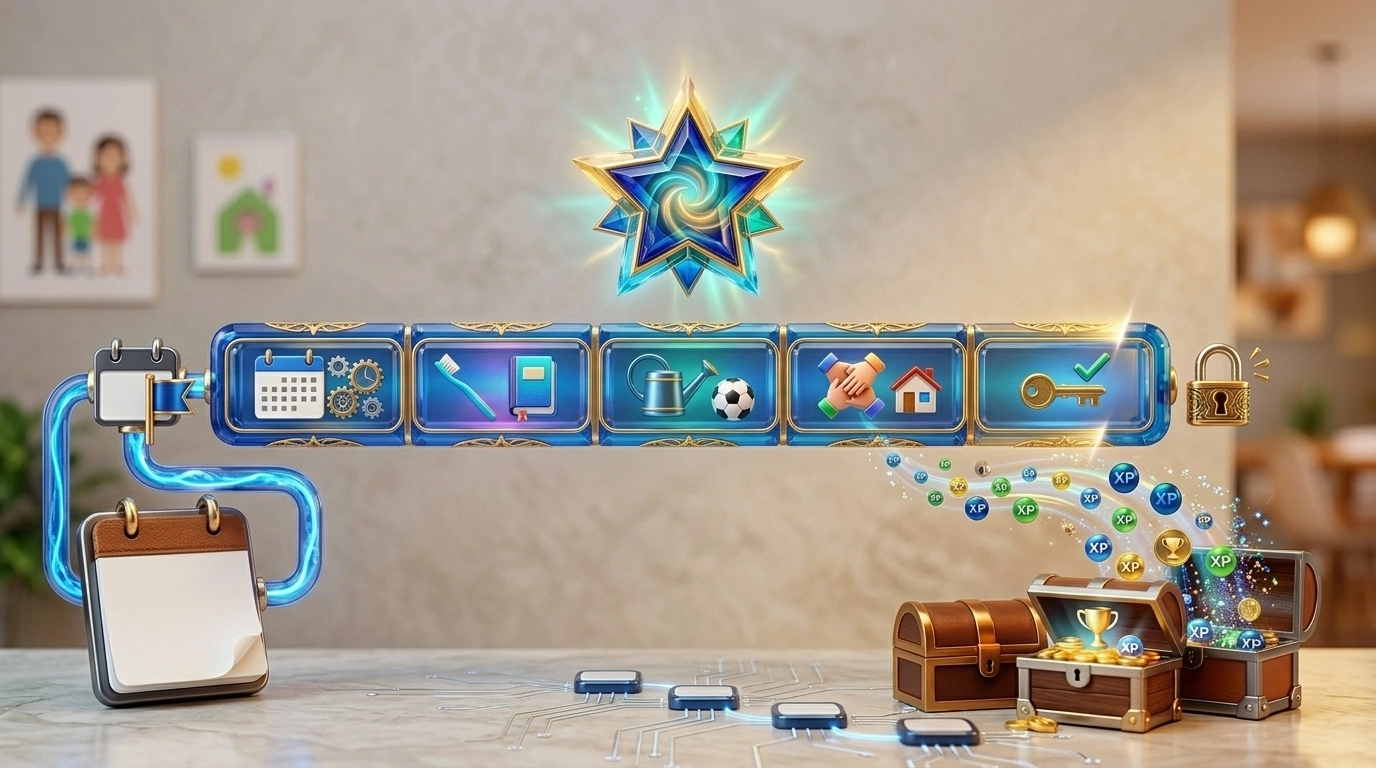
TRIGGER -> VISIBLE TASK -> PROOF VERIFICATION -> REWARD/XP
- Trigger: A specific time or event, such as 7:00 AM or "Arriving home from school".
- Visible Task: A clear, discrete action assigned to a specific person.
- Proof Verification: A photo or check-in that confirms the task is done, providing neutral proof.
- Reward/XP: Immediate feedback that acknowledges the effort and contributes to long-term progress.
Feature Spotlight: The Mechanics of Household Parity
HausFlow is designed to make invisible labor visible. For kids, this means moving from "doing chores because I'm told" to "contributing to the household ecosystem."
Visible Ownership and Fairness
In the HausFlow interface, tasks are not just a list; they are assigned. This creates a sense of Visible Ownership. When a child sees their name next to "Feed the Dog," they understand that they own that responsibility.
The Fairness Snapshot allows parents to see the distribution of work across the family. This data-backed approach prevents the "who does more?" arguments and ensures that the workload is balanced sustainably.
The XP and Rewards System
We use game mechanics not as a gimmick, but as a way to provide scaffolding for habit formation.
- XP (Experience Points): Every completed task in a Harmony Flow earns XP. This tracks consistency over time.
- Rewards: These are parent-defined incentives, such as extra screen time or choosing the Friday movie.
By tying XP to rewards, you create a tangible link between contribution and benefit.
Designed & Dynamic Notifications
Standard reminders are often easy to ignore because they feel flat, repetitive, and disconnected from the rhythm of the home. A steadier system uses recurring prompts that are engaging, visual, and clearly tied to the flow that is happening right now.
In practice, this means notifications should function as part of the operating layer, not as random interruptions.
- Recurring Prompts: Notifications repeat on a defined cadence so the system supports follow-through without requiring a parent to restate the task.
- Visual Context: Prompts should feel designed, with clear icons, progress cues, repeat-loop signals, and recognizable flow states that help a child quickly understand what is next.
- Lower Friction: A dynamic prompt is easier to respond to than a plain reminder because it provides structure, not just pressure.
- Calm Engagement: The goal is not urgency. The goal is a prompt that is noticeable, useful, and less boring than a standard reminder while still feeling calm.
The logic is simple:
FLOW TRIGGER -> DESIGNED PROMPT -> CLEAR ACTION -> STEADIER FOLLOW-THROUGH
Implementation: Setting Up Your First Harmony Flow
To move from the philosophy of Mavaro Systems to the current reality of your living room, follow this implementation guide. We recommend starting with the Morning Flow, as it is typically the time of highest friction.
Step 1: Define the Sequence
Keep it simple. A complex system is a brittle system. Identify the 3-5 essential tasks.
- Example: Get dressed -> Eat breakfast -> Pack bag -> Brush teeth.
Step 2: Set Visible Ownership
Assign each task in the HausFlow app. Ensure the child knows exactly what "done" looks like. Tip: use the proof feature to require a photo of the made bed.
Step 3: Launch the Flow
Set the trigger. When the flow starts, the HausFlow app will provide calm prompts to the family members involved.
Step 4: The Review and Reset
At the end of the week, use the Guided Check-in. Look at the XP earned. If the flow felt heavy or caused friction, adjust the tasks. This is the Review -> Reset part of our OS.
Why Calm-Tech Matters in Parenting
We live in an era of high-pressure technology: apps that beep, vibrate, and demand our attention with urgency. HausFlow is built on Calm-Tech principles. Our prompts are gentle. Our interface is clean and minimalist.
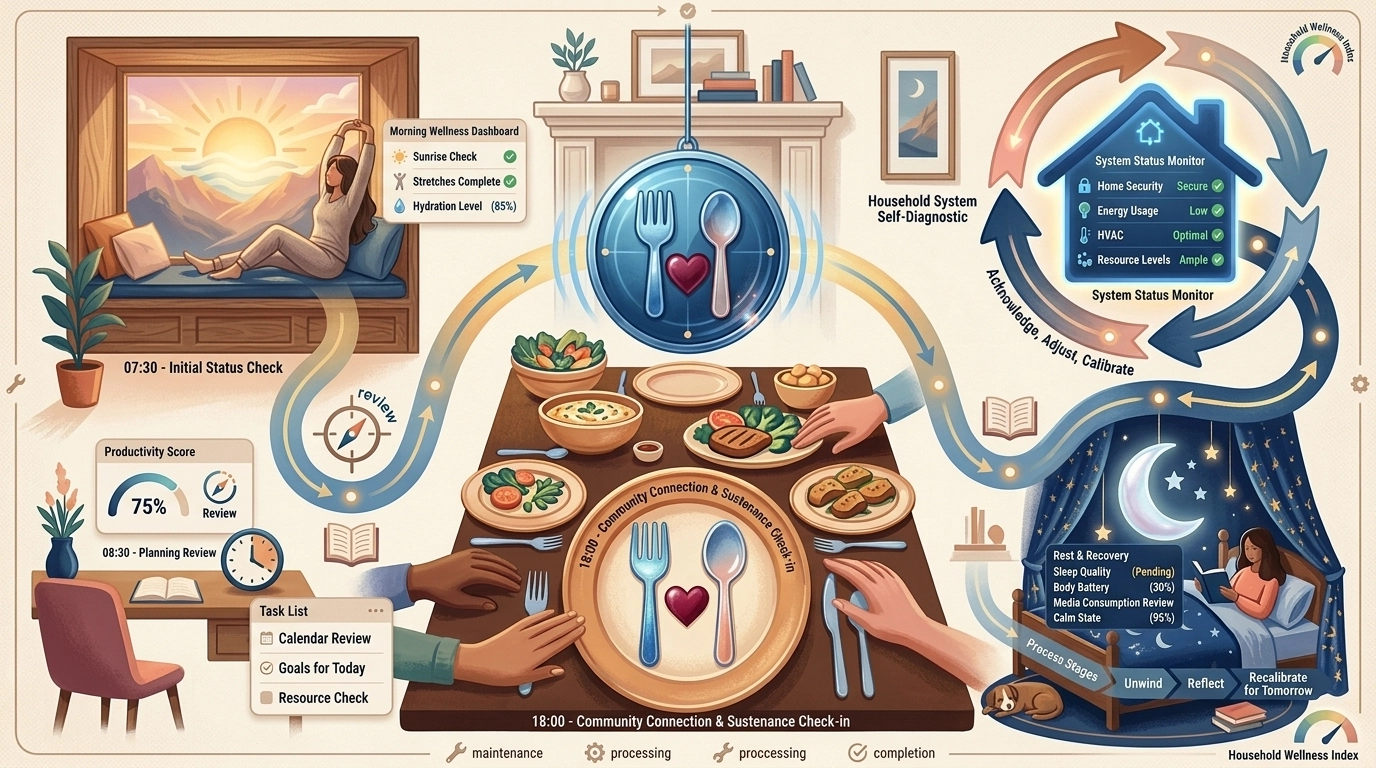
The goal is not to add more digital noise to your life, but to provide a quiet, steady scaffolding that supports your family's daily rhythm. When the system is calm, the family remains calm.
From Chaos to Clarity: A Sustainable Path
The goal of implementing Harmony Flows is not perfection. There will still be mornings when the milk spills or the shoes go missing. Life is inherently messy.
However, by using the Mavaro Systems - Behavioral OS, you are no longer fighting against the chaos with your bare hands. You have a framework. You have a system that handles the repetitive, boring labor of coordination, freeing you up to focus on what actually matters: your relationship with your children.
Stop nagging. Start building a system that works for your family.
Ready to build your first Flow? Explore our documentation on Harmony Flows or learn more about the Mavaro Systems philosophy.
Sustainability is the priority. Progress is the goal. Calm is the result.