From Chaos to Clarity: Using the Behavioral OS to Share Household Duties Without the Drama
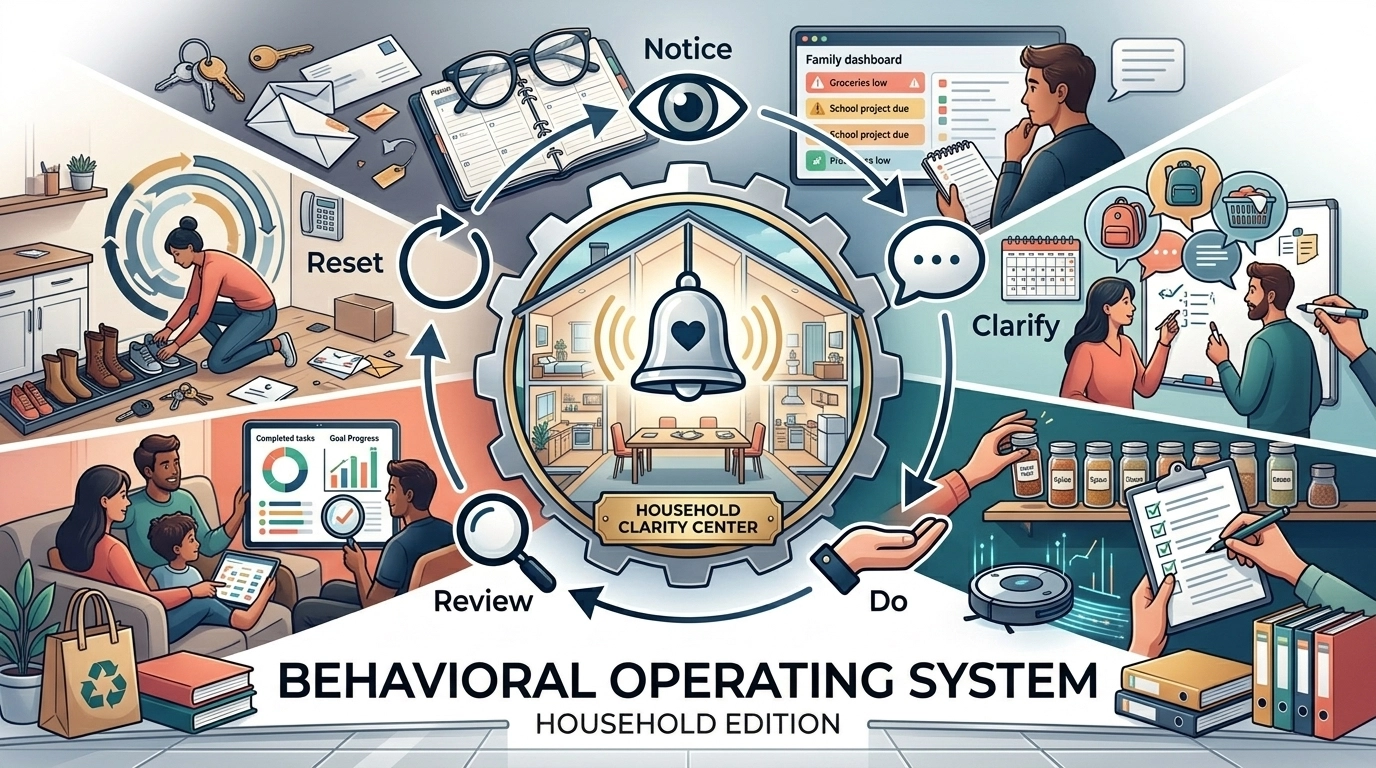
Most household management systems fail because they rely on the one thing humans are notoriously bad at maintaining: intensity.
We approach chores with a burst of willpower. We buy a new whiteboard, color-code a calendar, or spend a Sunday afternoon "getting organized." By Wednesday, the board is blank, the calendar is outdated, and the resentment is back. This is the intensity trap. It is an attempt to solve a structural problem with a psychological state.
At HausFlow, we view the household not as a collection of people who need to try harder, but as a system that needs a more reliable operating layer. We call this the Mavaro Systems - Behavioral OS.
By shifting from willpower to a system-first logic, you can move away from the drama of "Who forgot what?" and toward the clarity of "How does the system work?"
The Core Framework: The Six-Step Cycle
The Mavaro Systems - Behavioral OS is a steady, six-stage loop designed to reduce cognitive load and eliminate the need for nagging. It is built on two core principles that apply across the full framework:
- Systems over willpower: reliable structure beats bursts of motivation.
- Neutral accountability: the system holds the expectation so people do not have to carry it through reminders, pressure, or blame.
This matters because most household friction is not caused by bad intent. It is caused by invisible labor, vague expectations, uneven ownership, and no clear recovery path when life gets messy. The Behavioral OS gives households an operating layer that turns those friction points into a repeatable rhythm.
The full logic looks like this:
NOTICE -> CLARIFY -> DO -> REVIEW -> RESET -> REPEAT
Each step does a specific job. Together, they create a sustainable household management system.
1. NOTICE
NOTICE is the awareness layer. It is the moment a need, breakdown, or recurring point of friction becomes visible.
In a standard household, this often lives in one person's head. They notice the sink is full, the lunch supplies are low, the bathroom is slipping, or bedtime keeps running late. That mental tracking is invisible labor. It consumes attention before any task is even assigned.
In the Mavaro Systems framework, NOTICE is not about reacting emotionally. It is about observing the system without judgment.
What NOTICE does:
- Captures friction before it turns into resentment
- Makes invisible labor visible
- Creates a shared starting point for action
- Separates observation from blame
A useful distinction here is that NOTICE does not require an immediate fix. It only requires that the household sees the pattern clearly enough to stop treating it like a personal failure.
Example:
- "Trash keeps overflowing by Thursday"
- "No one knows whose turn it is to unload the dishwasher"
- "The morning routine falls apart when one person is running late"
These are not character defects. They are signals. NOTICE turns them into usable system inputs.
2. CLARIFY
CLARIFY is where the household translates a vague need into an executable structure. This is one of the most important parts of the framework because confusion is the primary source of avoidable friction.
"Clean the kitchen" is not clear. Different people will define it differently. That mismatch creates disappointment, rework, and tension. CLARIFY removes that ambiguity.
CLARIFY is the process of defining what a task actually is, who owns it, when it happens, and what done means.
What CLARIFY does:
- Defines the scope of the task
- Assigns visible ownership
- Sets expectations in advance
- Reduces decision fatigue during execution
Questions CLARIFY should answer:
- What exactly needs to happen?
- Who owns this?
- How often does it repeat?
- What counts as complete?
- Does proof or confirmation matter?
When you clarify well, the DO phase becomes lighter because the thinking has already been handled upstream. This is systems over willpower in practice. Instead of asking people to remember, interpret, and negotiate in the moment, you build a steadier structure ahead of time.
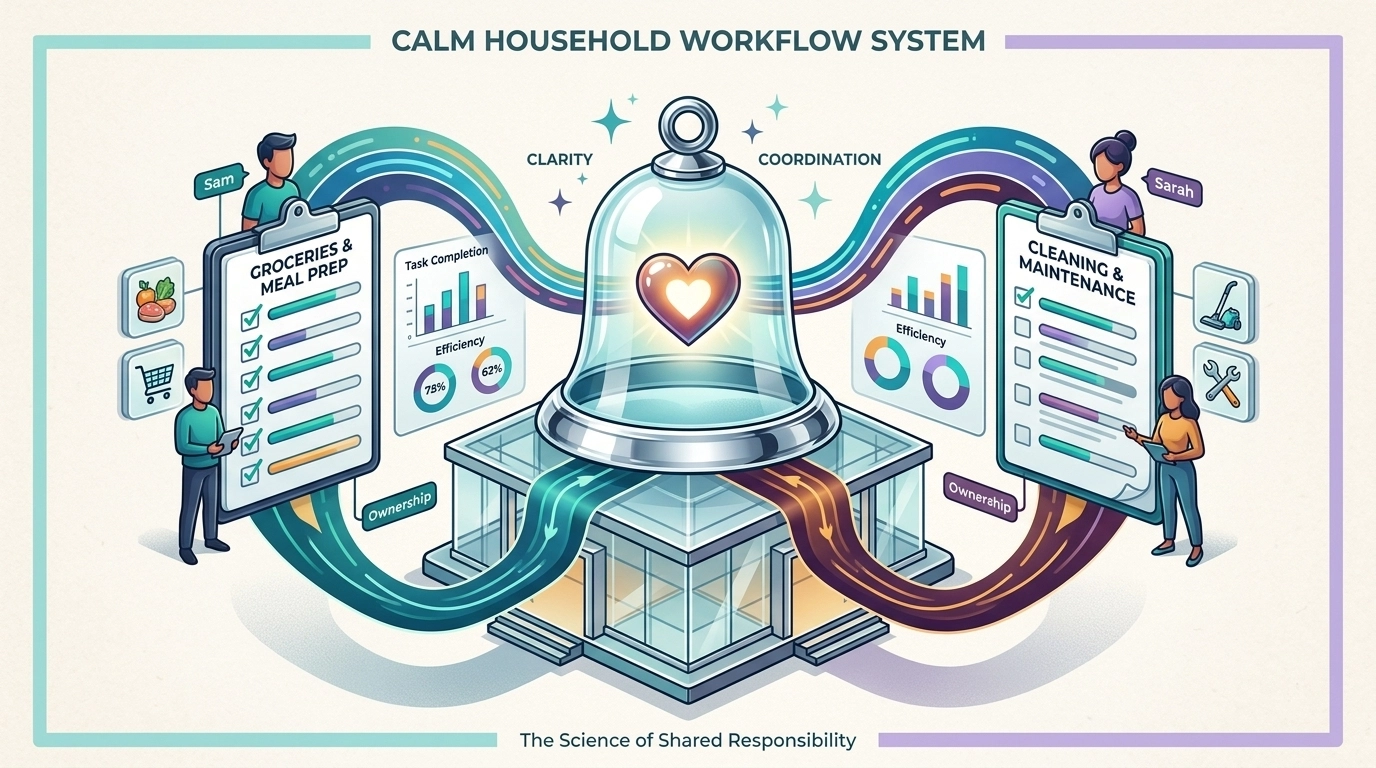
Making Invisible Labor Visible
One of the greatest stressors in shared living, whether for families or roommates, is the imbalance of cognitive labor. One person often acts as the Captain, tracking every deadline, while others act as Crew, waiting for instructions.
The Behavioral OS breaks this dynamic by externalizing the Captain role into the software.
The logic of visibility:
NOTICE -> CLARIFY -> SYSTEM OWNERSHIP
When a task is clarified and assigned in a system like HausFlow, it moves from someone's brain into a shared digital space. This provides neutral accountability. It is no longer a partner or roommate saying, "You forgot the trash." It is the system indicating that the task is pending.
This is a key part of the Mavaro Systems logic. Accountability should be visible and calm. It should reduce relationship strain, not increase it. The more the system carries the reminder layer, the less households have to rely on memory, chasing, or emotional escalation.
3. DO
DO is the execution layer. This is where the household carries out the task or routine using the structure built in the earlier steps.
The DO phase should be the easiest part of the cycle. If NOTICE surfaced the right issue and CLARIFY defined it well, DO requires very little interpretation. You simply follow the Harmony Flow, the pre-defined steps for that routine.
We focus on frictionless execution. The system provides gentle prompts, not high-pressure alarms. It is a steady rhythm rather than a loud interruption.
What DO depends on:
- Clear ownership
- Clear definition of done
- A visible routine or checklist
- Timing that fits real life
This is another place where systems over willpower matters. A weak system asks people to remember everything at the exact right moment. A stronger system reduces the number of choices and makes action easier to start.
In practical terms, DO is not just about getting something finished. It is about making completion more repeatable and less emotionally expensive.
4. REVIEW
In most households, the Review phase is just a fight. In the Behavioral OS, REVIEW is a neutral look at the data.
- Did the system work?
- Were the tasks completed as clarified?
- Is the workload balanced?
This is not about blaming. It is about checking the health of the system. If a task is not getting done, the question is not "Why are you lazy?" but "Where is the friction in the CLARIFY or DO phase?"
That shift matters. REVIEW is where neutral accountability becomes visible in practice. Instead of assigning moral meaning to a miss, the household examines the structure.
REVIEW helps households ask:
- Was the task definition too vague?
- Was the ownership unclear?
- Was the routine timed poorly?
- Was the workload uneven?
- Did the system prompt too late or not clearly enough?
A healthy REVIEW phase protects relationships because it keeps the focus on implementation, not identity. The goal is not to prove who cares more. The goal is to refine the operating layer so follow-through becomes steadier over time.
Visualizing the Logic: The Flow
To understand how these steps interact, look at the progression of a household duty from a vague thought to a finished routine:
The Friction Loop:
Vague Expectation -> Confusion -> Procrastination -> Shame -> Resentment
The Behavioral OS Loop:
NOTICE -> CLARIFY -> DO -> REVIEW -> RESET -> REPEAT
Another way to understand the logic is by function:
- NOTICE identifies friction
- CLARIFY structures the response
- DO executes the routine
- REVIEW evaluates the result
- RESET recovers from disruption
- REPEAT turns the cycle into a sustainable rhythm
This is why the framework works as a system rather than as a motivational tactic. Each step supports the next. No single step has to carry the entire burden.
5. RESET
Life happens. Kids get sick, work gets busy, and roommates go out of town. Most systems break permanently when they hit a hurdle. The Behavioral OS includes a RESET stage: a built-in mechanism for gentle recovery.
The RESET allows you to clear the backlog and start fresh without the weight of past failures. It prevents the shame spiral that often follows a week of missed chores. You simply reset the board and return to the rhythm.
RESET is essential because sustainable systems are not defined by perfection. They are defined by recoverability.
What RESET does:
- Acknowledges disruption without dramatizing it
- Prevents backlog from turning into avoidance
- Re-establishes a workable baseline
- Protects the household from blame cycles
Without RESET, households often abandon a system the moment it becomes imperfect. With RESET, the framework stays usable even when real life interrupts the plan. That is a core part of systems over willpower. The system does not assume ideal conditions. It assumes human conditions.
6. REPEAT
Consistency is the only metric that matters in household management. The REPEAT phase is about sustainability. We do not want a clean house for a day. We want a sustainable home rhythm for the long term.
By repeating the cycle, the system becomes a scaffolding for your life. It supports your behavior until the structure itself becomes effortless.
REPEAT is where the full Mavaro Systems logic comes together. A household does not become calmer because everyone suddenly gains more discipline. It becomes calmer because the cycle keeps running:
NOTICE surfaces what matters.
CLARIFY defines it.
DO makes action frictionless.
REVIEW improves the implementation.
RESET restores function after disruption.
REPEAT makes the rhythm sustainable.
Over time, this repeated loop reduces cognitive load, lowers tension, and creates parity in the shared labor of running a home. That is the purpose of the framework. It turns household management from a recurring emotional negotiation into a steadier operating system.
Transitioning to Digital Scaffolding
Moving these concepts from philosophy to reality requires the right tools. While you can implement the Behavioral OS with a notebook and a lot of conversations, HausFlow is built specifically to serve as this operating layer.
How HausFlow Implements the OS
- Visible Ownership: Every job has a clear owner. No more "I thought you were doing it."
- Harmony Flows: Recurring routines are pre-clarified. You do not have to rethink the steps every week.
- Proof Verification: A neutral way to confirm done without needing to double-check each other.
- Guided Check-ins: Structured resets to ensure the system stays healthy.
Summary: Systems Over Willpower
The goal of the Mavaro Systems - Behavioral OS is not perfection. It is about moving from a state of chaotic reaction to a state of calm clarity. By focusing on the full system, NOTICE -> CLARIFY -> DO -> REVIEW -> RESET -> REPEAT, you remove the personal drama from household duties and replace it with a steadier operating layer.
The logic is simple, but the effect is cumulative:
- NOTICE makes invisible labor visible
- CLARIFY removes ambiguity and defines ownership
- DO makes execution more frictionless
- REVIEW checks the system without blame
- RESET provides recovery when life gets messy
- REPEAT turns the framework into a sustainable household rhythm
This is why the Mavaro Systems framework emphasizes systems over willpower. Motivation rises and falls. Household life stays demanding. A calm, repeatable structure will outperform intensity every time.
It also explains why neutral accountability matters. When expectations live in a shared system instead of one person's memory, the household spends less energy on reminding, defending, and resenting. The system carries the load more evenly.
You stop fighting about the chores and start refining the system.
Key Takeaways for a Calmer Home:
- Lower the intensity: Focus on a steady rhythm rather than a burst of effort.
- Define done: Spend more time in the CLARIFY phase to save time in the DO phase.
- Use neutral prompts: Let the system provide the reminders, not your voice.
- Review the structure, not the person: Look for friction in the system before assigning blame.
- Embrace the reset: Do not let a bad week ruin a good system.
- Commit to repetition: Sustainable follow-through comes from repeating the loop, not from doing it perfectly once.
For more information on setting up your household operating system, visit our documentation and start building your first Harmony Flow today.
Mavaro Systems LLC - HausFlow is the shared coordination platform for families and roommates who value structure that supports relationships.