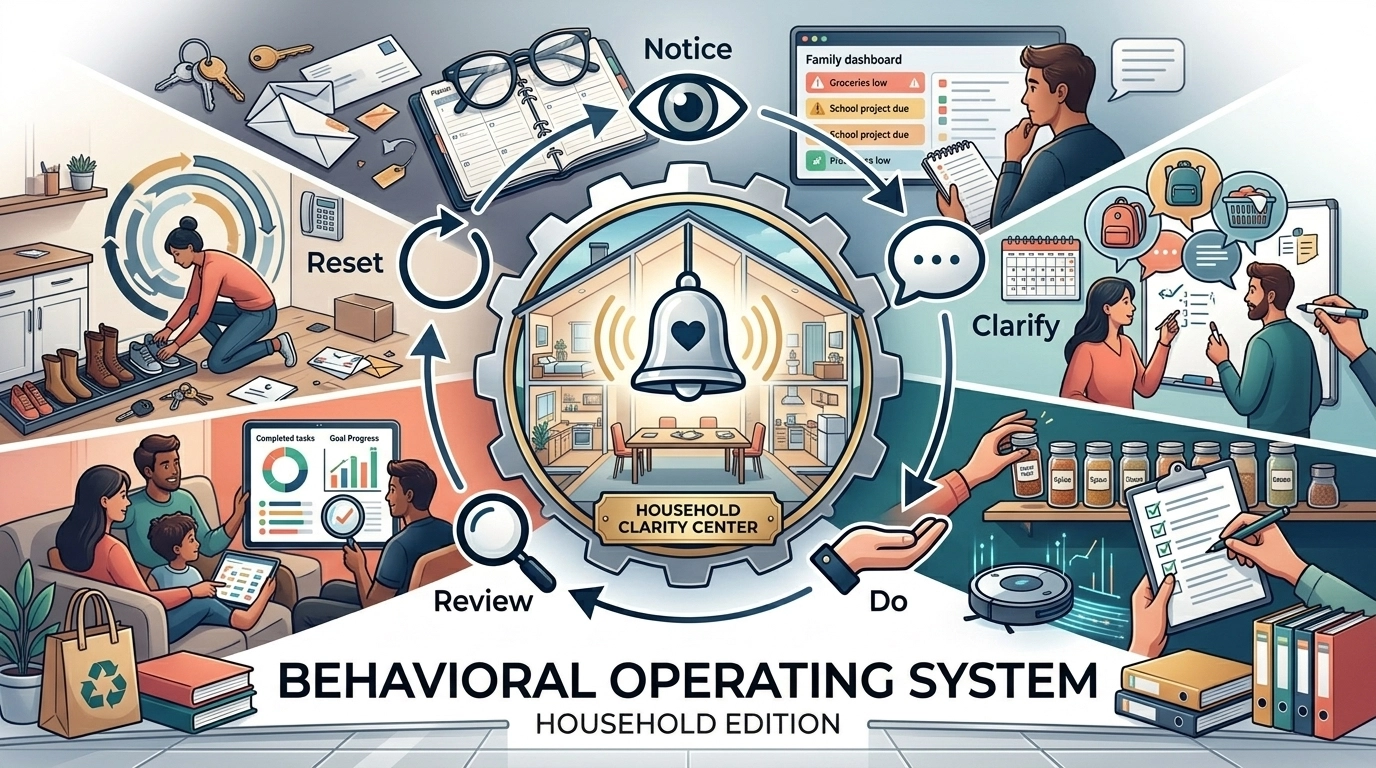
7 posts tagged with "behavioral-os"

View All Tags

HausFlow Roommate: Visible Parity Without Scorekeeping

· 4 min read

HausFlow Editorial
Behavioral Systems Writer

Shared living usually starts with goodwill and vague expectations.

Everyone agrees the kitchen should stay usable. Everyone agrees supplies should not run out. Everyone agrees guests, packages, bills, quiet hours, and recurring household work should be handled like adults.

Then real life begins.

The issue is rarely that roommates do not care. The issue is that shared homes often run on memory, tolerance, and private resentment instead of a visible operating layer.

HausFlow Roommate exists for that gap.

The Mavaro Behavioral OS: Why Your Household Runs on Systems, Not Willpower

· 5 min read
HausFlow Editorial
Behavioral Systems Writer

The Mavaro Behavioral OS

Most people believe that an organized home is the result of disciplined people. They assume that if they were just a little more motivated, or if their partner was just a little more "mindful," the dishes would be done, the laundry would be folded, and the chaos would subside.

This is the Willpower Fallacy.

At Mavaro Systems, we believe that relying on willpower to manage a household is like trying to power a city with a single AA battery. It is a finite resource that is almost always depleted by the time you actually need it. To move from chaos to clarity, you do not need more motivation. You need a better operating system.

Why Most Chore Apps Fail: The Best Chore Chart for Adults and Families

· 7 min read
HausFlow Editorial
Behavioral Systems Writer

A vibrant illustration of a person moving from a chaotic, paper-filled room to a calm, organized digital interface.

Most household management apps are abandoned within the first three days. We have all been there. You download a household chore app or family organization app with high hopes of finally solving the "who does what" drama, you spend an hour inputting every single task from "scrub the baseboards" to "feed the cat," and by Tuesday, the notifications are being ignored. By Friday, the app is buried in a folder on the third screen of your phone, right next to that meditation app you used once in 2022.

The failure is rarely due to a lack of effort. It is due to a fundamental flaw in how these systems are designed. Most apps treat household management like a video game for children or a rigid corporate spreadsheet. Neither of these models accounts for the messy, fluid reality of shared living.

At HausFlow, we believe that managing a home is not just about checking boxes. It is about managing the mental load and creating a system that supports human behavior rather than straining it.

The Death of the Digital Nag: Why Supportive Systems Beat Pressure in Household Management

· 6 min read
HausFlow Editorial
Behavioral Systems Writer

heroImage

Life at home is rarely a linear sequence of events. It is a complex, overlapping web of domestic logistics: grocery replenishment, extracurricular coordination, laundry cycles, and the persistent question of "what’s for dinner?"

For many, the solution has been to turn to technology. However, most household management apps today act as digital nags. They are built on a foundation of high-pressure notifications, shame-inducing red badges, and a reliance on the user's raw willpower to just get it done.

At HausFlow, we believe this approach is fundamentally flawed. By forcing a high-energy optimization mindset onto the home, these apps often add to the very mental load they claim to solve. Built on the Mavaro Systems Behavioral OS, HausFlow is designed to be a calm, supportive operating layer: a system that prioritizes structural consistency over intense willpower.

From the Kitchen to the Boardroom: Why Your Home and Business Need the Same Operating System

· 5 min read
HausFlow Editorial
Behavioral Systems Writer

From the Kitchen to the Boardroom

For too long, we have treated our personal lives and our professional lives as two distinct biological states. We assume that the high-stakes coordination of a corporate boardroom requires a "system," while the daily management of a household can be sustained by sheer willpower and a few sticky notes.

The reality is that human behavior does not change just because the setting does. Whether you are managing a Fortune 500 team or a household of four, the underlying friction is the same: invisible labor, vague expectations, and the inevitable "shame spiral" that occurs when willpower fails.

At Mavaro Systems, we believe that life: all of it: requires a reliable operating layer. This is why we built the Mavaro Behavioral OS, the foundational logic behind HausFlow today and future coordination layers on our roadmap.

From Chaos to Clarity: Using the Behavioral OS to Share Household Duties Without the Drama

· 11 min read

heroImage

Most household management systems fail because they rely on the one thing humans are notoriously bad at maintaining: intensity.

We approach chores with a burst of willpower. We buy a new whiteboard, color-code a calendar, or spend a Sunday afternoon "getting organized." By Wednesday, the board is blank, the calendar is outdated, and the resentment is back. This is the intensity trap. It is an attempt to solve a structural problem with a psychological state.

At HausFlow, we view the household not as a collection of people who need to try harder, but as a system that needs a more reliable operating layer. We call this the Mavaro Systems - Behavioral OS.

By shifting from willpower to a system-first logic, you can move away from the drama of "Who forgot what?" and toward the clarity of "How does the system work?"

Why Your Family Organization App is Failing You (and How HausFlow is Different)

· 6 min read
HausFlow Editorial
Behavioral Systems Writer

Why Your Family Organization App is Failing You

Most families begin their journey into digital organization with a burst of optimism. They download a popular family organization app, spend three hours inputting every conceivable chore, and assign colors to every family member. For exactly four days, the house runs like a clock.

By day seven, the notifications start to feel like noise. By day fourteen, the "overdue" red badges have become a permanent, stressful fixture of the home screen. By the end of the month, the app is deleted or ignored, and the household returns to its previous state of "loud chaos": where expectations are vague, labor is invisible, and follow-through depends entirely on someone’s current energy level.

The problem isn't the family. The problem is the software. Most household management tools are built as "digital nag-boxes": systems designed to create pressure rather than support behavior.

At HausFlow, we’ve built something different. By leveraging the Mavaro Systems Behavioral OS, we’ve moved past simple task lists to create a dedicated operating layer for the home.